42°21′ N   83°04′ WINDEPENDENT CITY GUIDE · HU / ENDETROIT + MICHIGAN
QUARTER
DETROIT
Menu
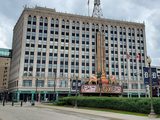
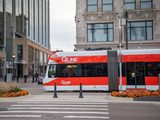
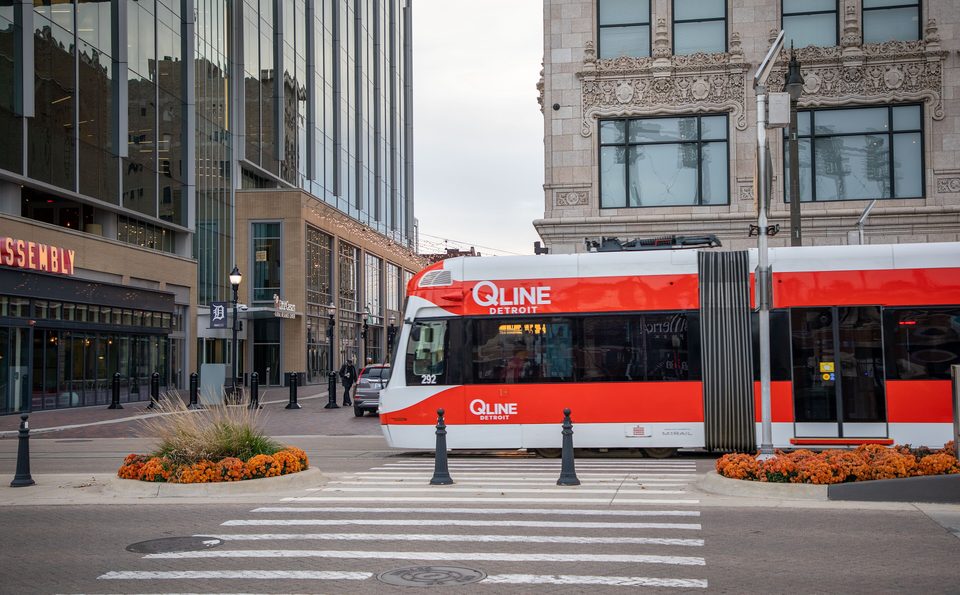
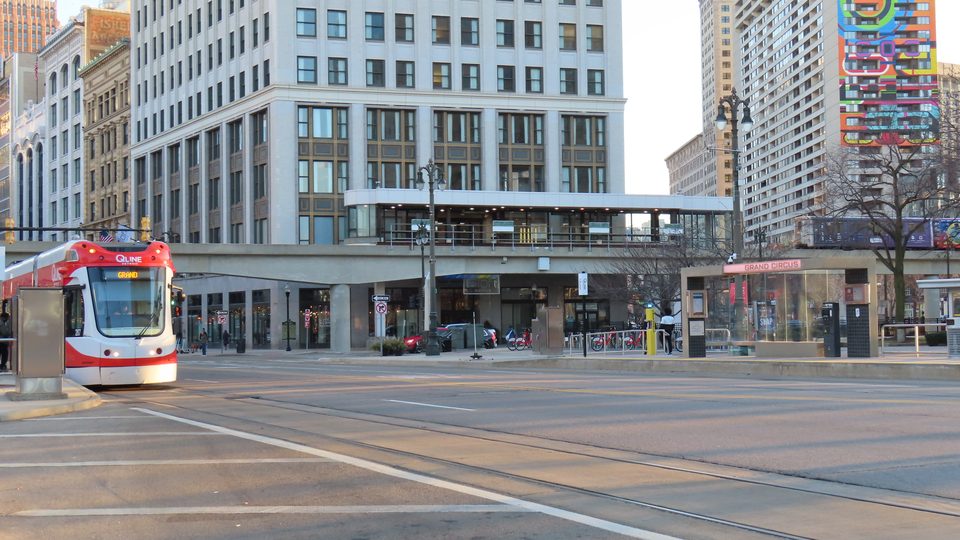
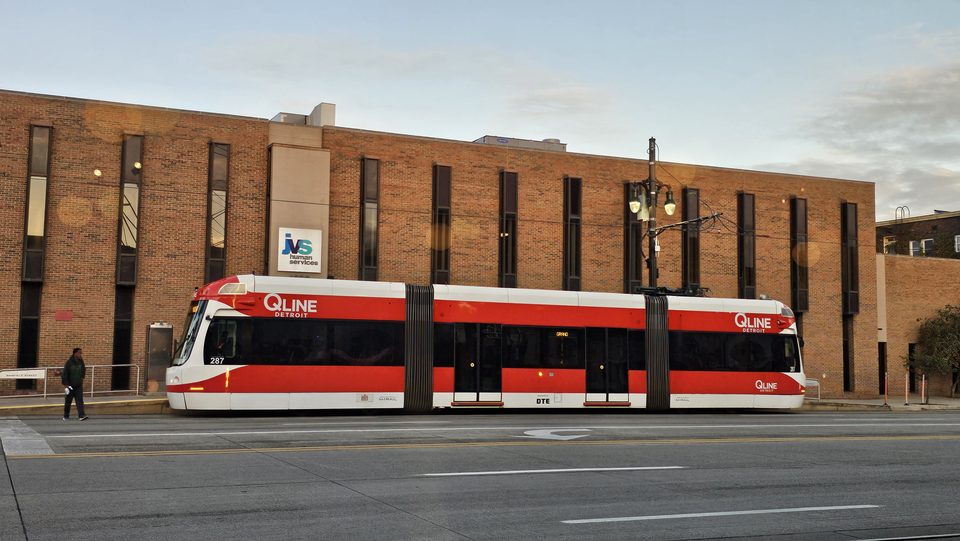
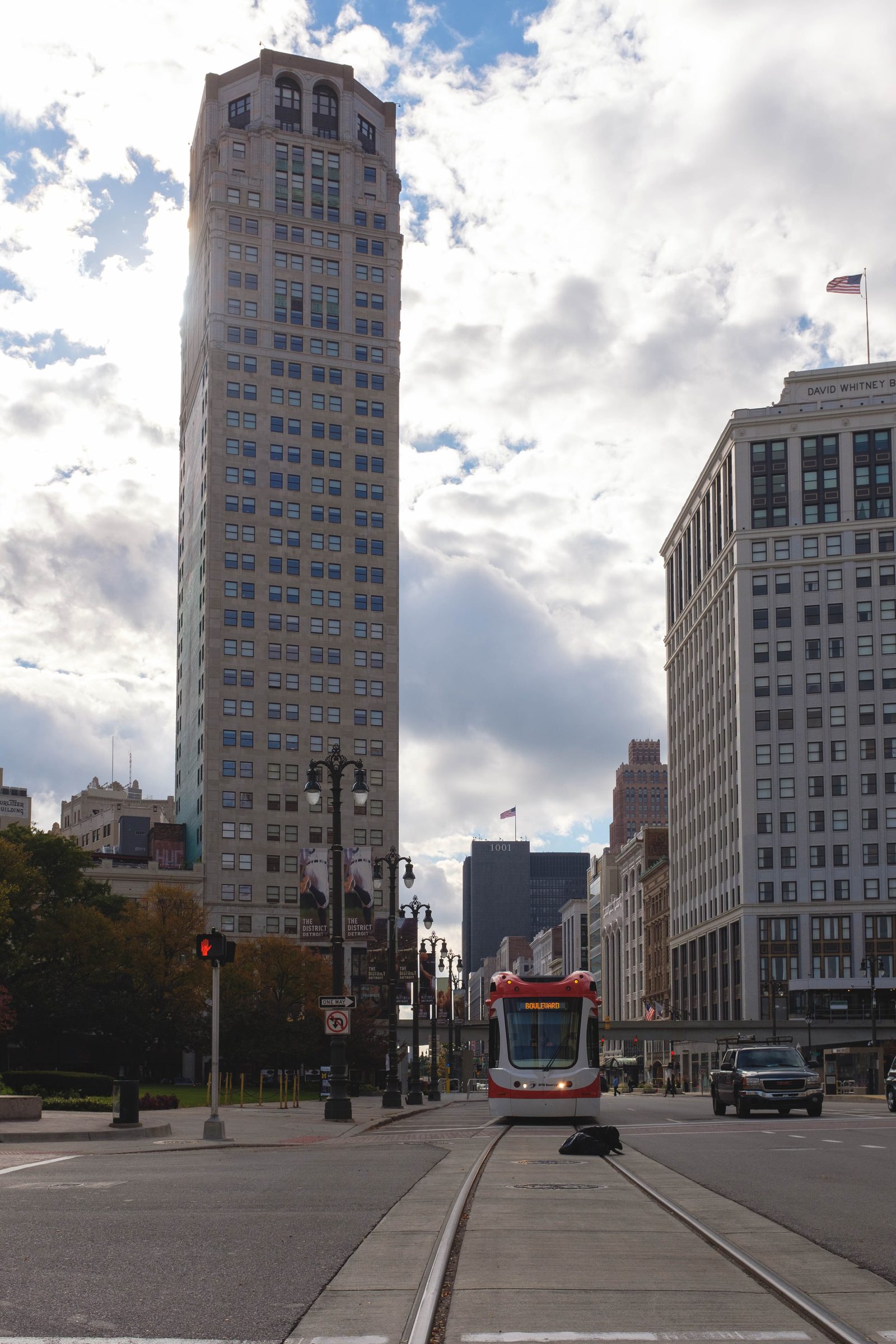
A QLINE streetcar on Woodward Avenue near the Fox Theatre (2021)
Bluediamond616 · CC BY-SA 4.0

Transit Places / ¼

The Woodward Avenue streetcarQLINE

A battery-powered streetcar on Detroit’s main street, free

Six streetcars, 12 stops and 24 minutes from the Detroit River to New Center. After a 61-year gap, rail returned to Woodward Avenue in 2017, largely paid for by private donors, and on most of the line the cars run without overhead wire, on batteries. Hop on, it’s free.

4 streetcars on Woodward right now (timetable)
Line
3.3 miCongress Street – Grand Boulevard
Stops
1220 platforms in two directions
Trip
24 minend to end
Frequency
15 minseven days a week
Off-wire
≈ 60%of the line, on battery
Fare
$0since September 2021

01 / The streetcar

The streetcar that business built

On April 8, 1956 a streetcar bearing the banner “The Journey’s End” rolled into the Woodward carhouse for the last time, and Detroit, the Motor City, went 61 years without streetcars. On May 12, 2017 a bell rang on the same avenue again: the QLINE’s first riders boarded at Grand Circus Park.

The line was built not by a public transit agency but by a non-profit, M-1 RAIL. Roger Penske, Dan Gilbert, the Kresge Foundation and dozens of companies, hospitals and universities put up most of the money, with federal, state and county funds filling the gaps. Sponsors adopted the stops, and Quicken Loans bought the name. As promised, in 2024 the founders handed the line to the region’s transit authority, the RTA.

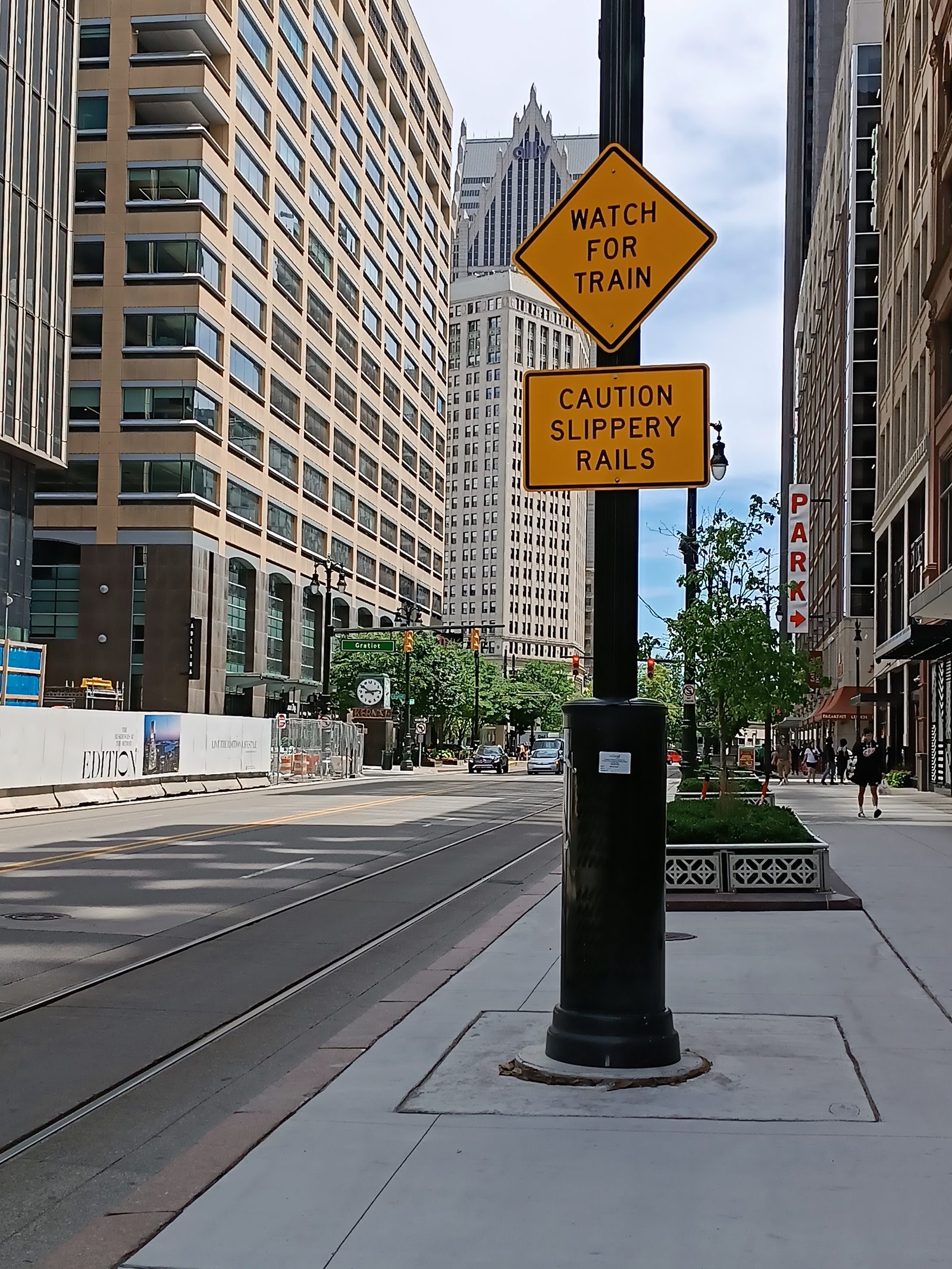
On most of Woodward the cars run without overhead wire, on lithium-ion batteries, so across most of downtown no web of wires spoils the view of the Guardian Building, the Fox Theatre or Campus Martius. Along the way you stop by Comerica Park and Little Caesars Arena, the Detroit Institute of Arts, Wayne State University, the Amtrak station and beneath the Fisher Building’s tower. Since 2021 the ride has been free.
02 / The line

The Woodward streetcar, live

The whole line on an aerial photo, from Congress Street to Grand Boulevard. Streetcars move with live GPS positions when the RTA feed is available, and by the official timetable when it is not.

The QLINE along Woodward Avenue on an aerial photo 1. Congress StreetCongress Street2. Campus MartiusCampus Martius3. Grand CircusGrand Circus4. Montcalm StreetMontcalm Street5. Adelaide / SproatAdelaide / Sproat6. MLK / MackMLK / Mack7. Canfield StreetCanfield Street8. Warren AvenueWarren Avenue9. Ferry StreetFerry Street10. Amsterdam StreetAmsterdam Street11. Baltimore StreetBaltimore Street12. Grand BoulevardGrand Boulevard
QLINE trackstreetcar, live GPSstreetcar, by timetableAerial: USGS The National Map, USDA NAIP (public domain) · track: OpenStreetMap contributors (ODbL) · stops and timetable: official QLINE GTFS · live positions: RTA GTFS-realtime.

4 streetcars on Woodward right now (timetable)

  1. 12Grand BoulevardThe northern terminus below the Fisher Building’s tower; the streetcars sleep two blocks away.—17:15
  2. 11Baltimore StreetTrains to Chicago, buses to Pontiac: the QLINE’s big transfer hub, at the Amtrak station.17:0817:16
  3. 10Amsterdam StreetA center platform at the gateway to New Center, with park-and-ride next door and the Model T’s birthplace a nine-minute walk away.17:0717:17
  4. 09Ferry StreetArt, culture and history: the stop for the Detroit Institute of Arts and the Detroit Historical Museum.17:0517:04
  5. 08Warren AvenueThe gateway to Wayne State University and the museum district: the streetcar’s campus stop.17:0317:06
  6. 07Canfield StreetEat, drink, bowl: the Majestic, America’s oldest bowling alley and MOCAD at one stop.17:1617:08
  7. 06MLK / MackOne crossing, two names: Martin Luther King to the west, Mack to the east. Next door, the Detroit Symphony’s hall.17:1417:10
  8. 05Adelaide / SproatThe Little Caesars Arena stop, with two separate platforms and Detroit’s first red transit lane.17:1217:13
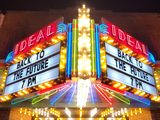
  9. 04Montcalm StreetThe heart of Foxtown: the Fox Theatre’s marquee, with the Tigers’ ballpark across the street.17:0917:15
  10. 03Grand CircusThe half-moon park where you can switch to the People Mover, and where the first riders climbed aboard in 2017.17:0717:17
  11. 02Campus MartiusThe city’s zero point: Detroit’s Mile Roads, 8 Mile included, are measured from here.17:0517:04
  12. 01Congress StreetThe riverside terminus: two blocks from the Detroit River, and the streetcar heads north from here.17:15—

Next departure by the timetable, in both directions. On Sundays the official hours end at 9 p.m., although the timetable file lists later departures. · timetable valid until: 2027-05-23

03 / Virtual ride

24 minutes from the river to New Center

Board at Congress Street and ride north up Woodward, stop by stop. Scroll, or start the automatic ride; switch on the sound for the bell.

  1. The Congress Street southern terminus (2023)
    42-BRT · CC BY-SA 4.0

    Stop 1 of 12

    Congress Street

    This is where the ride begins. The Congress Street platform sits in the middle of Woodward, two blocks from the Detroit River: behind you are the bronze giant of the Spirit of Detroit and Hart Plaza, ahead the towers of the Financial District. Across most of downtown there’s no overhead wire: the streetcar rolls on battery power.

    The stop’s full story ↗
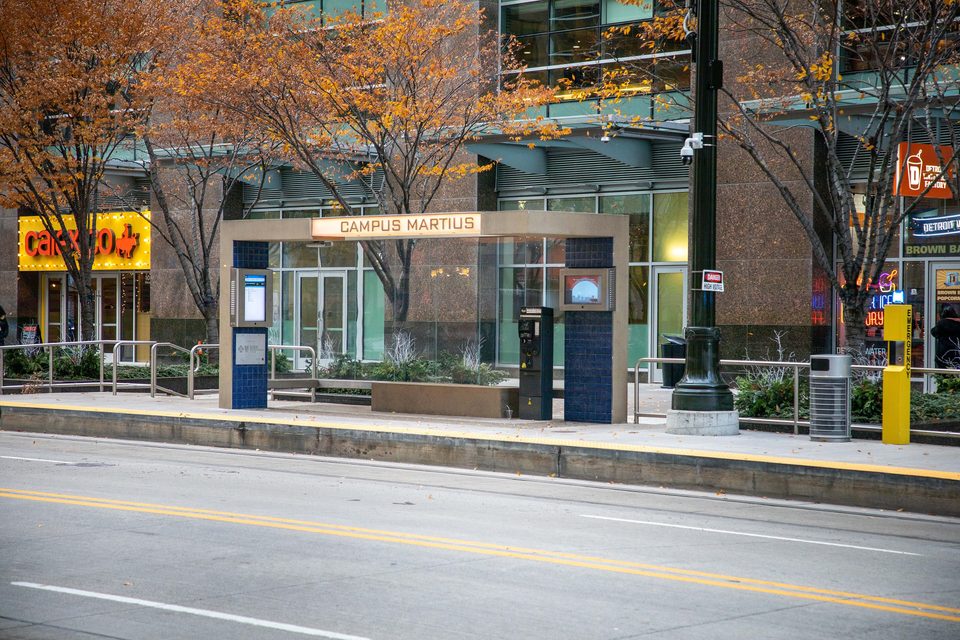
  2. The Campus Martius platform and shelter (2021)
    Bluediamond616 · CC BY-SA 4.0

    Stop 2 of 12

    Campus Martius

    Five minutes on, you reach the city’s living room. Campus Martius Park is the heart of downtown: an ice rink in winter, the lighting of the city’s Christmas tree on the Monday before Thanksgiving, with Rocket Mortgage’s headquarters and the new tower on the old Hudson’s store site all around. A medallion in the pavement marks the point from which Detroit’s Mile Roads are measured.

    The stop’s full story ↗
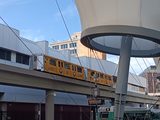
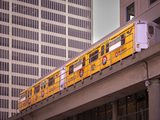
  3. Grand Circus Park: QLINE platforms below, the People Mover above (2023)
    42-BRT · CC BY-SA 4.0

    Stop 3 of 12

    Grand Circus

    Two minutes on, Woodward cuts the half-moon of Grand Circus Park in two. On your left the David Whitney Building, with a People Mover car gliding into its station overhead; on your right the Detroit Opera House. The ribbon was cut here on May 12, 2017, and the first riders set off from here.

    The stop’s full story ↗
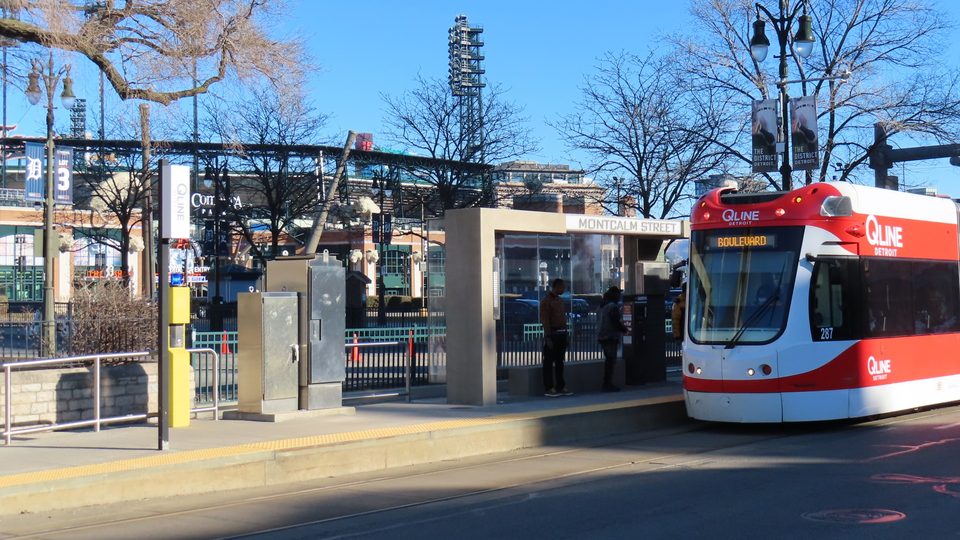
  4. The Montcalm Street stop, with Comerica Park behind (2023)
    42-BRT · CC BY-SA 4.0

    Stop 4 of 12

    Montcalm Street

    Two minutes on, the streetcar rolls into Foxtown. On your left the Fox Theatre, the largest surviving movie palace of the 1920s; on your right Comerica Park’s main entrance with its 15-foot tiger. There’s no overhead wire in front of the theater: the streetcar is running on battery.

    The stop’s full story ↗
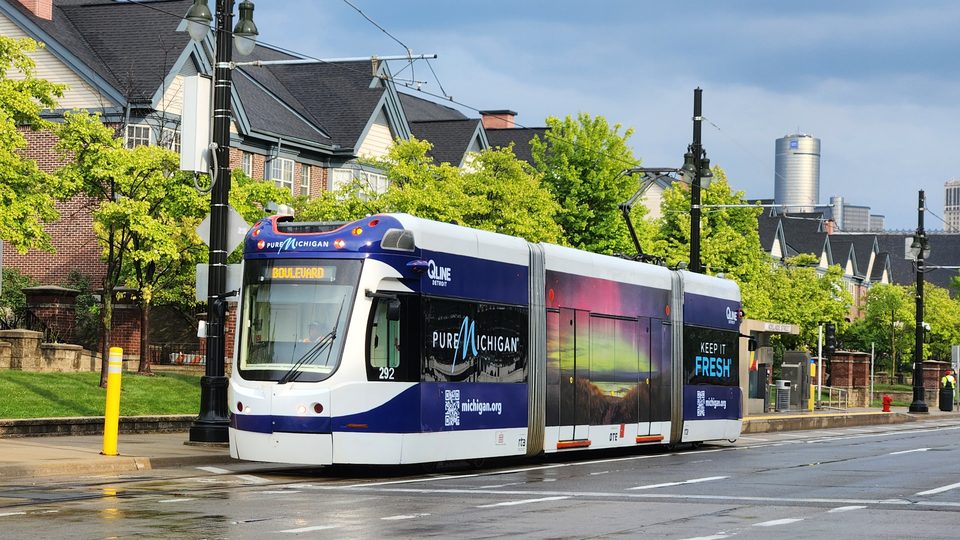
  5. Car 292 at the Adelaide Street stop (2025)
    42-BRT · CC BY-SA 4.0

    Stop 5 of 12

    Adelaide / Sproat

    Three minutes: the streetcar crosses the I-75 freeway and arrives in the District Detroit. On your left Little Caesars Arena, home of the Red Wings and the Pistons; on your right the Victorian mansions of Brush Park. The line’s longest wired section starts at Adelaide Street: from here to Canfield Street the streetcar charges its batteries from the overhead line.

    The stop’s full story ↗
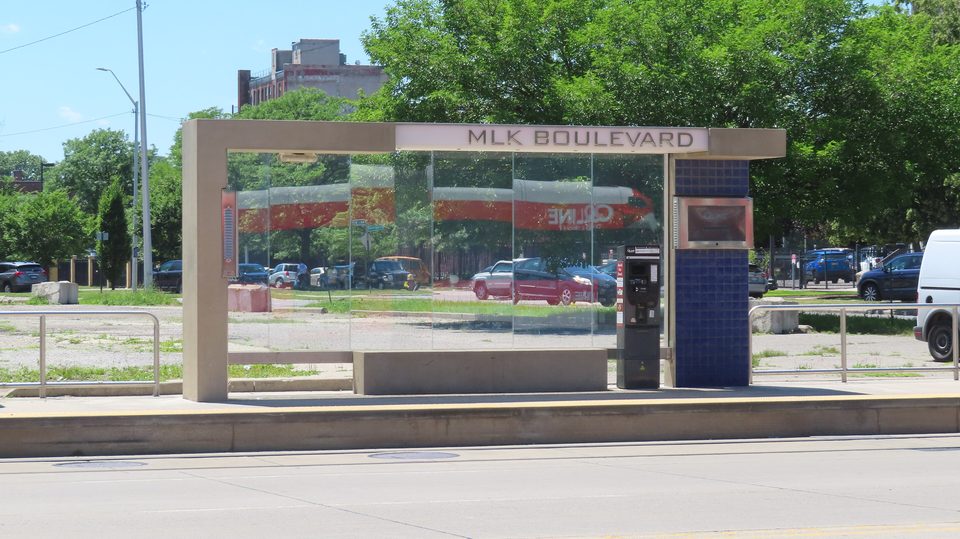
  6. The Martin Luther King Jr. Boulevard stop (2022)
    42-BRT · CC BY-SA 4.0

    Stop 6 of 12

    MLK / Mack

    Two minutes under the wire. The cross street changes its name at Woodward: Martin Luther King Jr. Boulevard to the west, Mack Avenue to the east. On your left, just before the stop, is Orchestra Hall, home of the Detroit Symphony Orchestra.

    The stop’s full story ↗
  7. A streetcar at the Canfield Street stop
    JJonahJackalope · CC BY-SA 4.0

    Stop 7 of 12

    Canfield Street

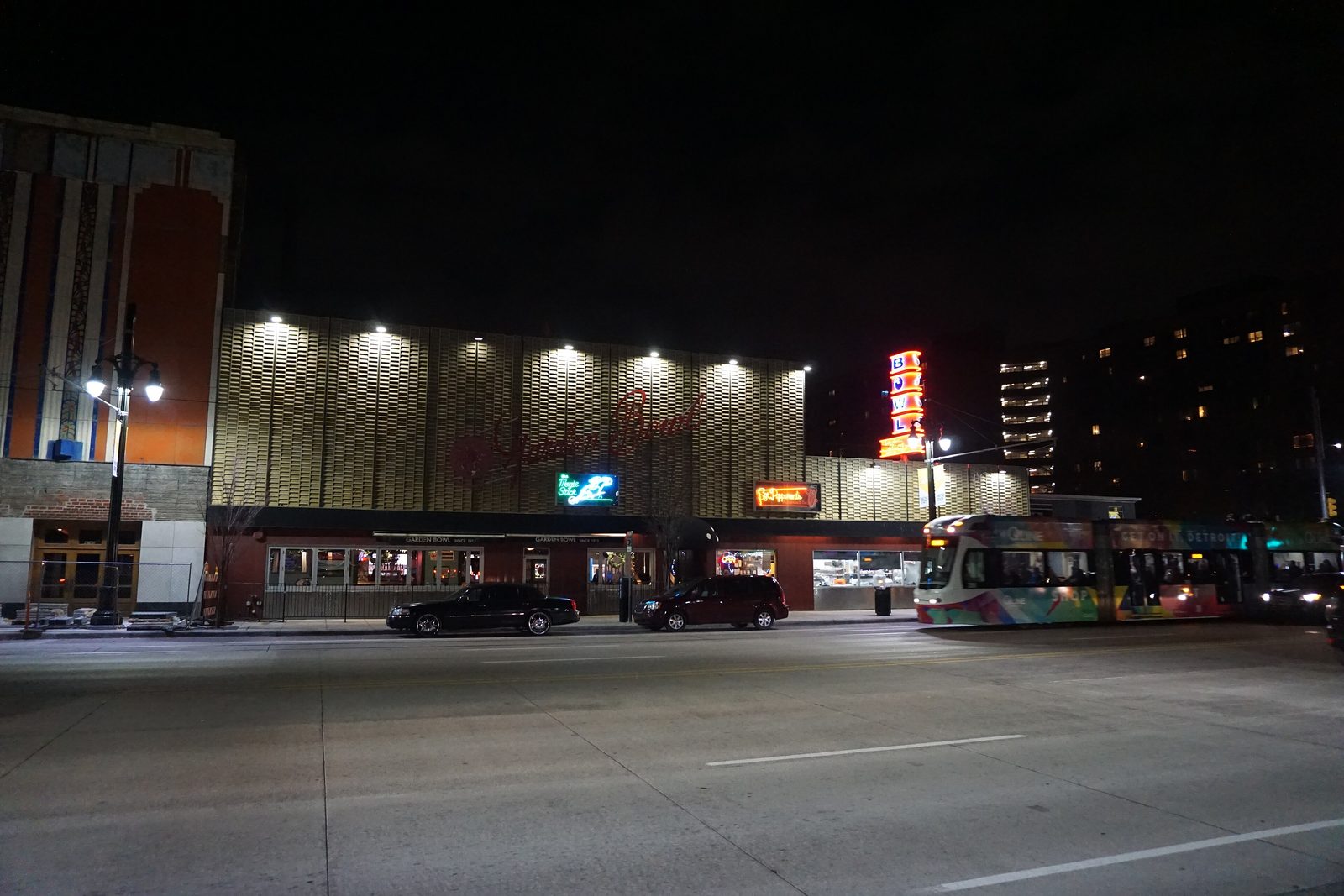
    Two minutes on, you reach one of Midtown’s liveliest corners. On your right the Majestic Theatre and the Garden Bowl, the oldest continuously operating bowling alley in the country, then MOCAD in its former car showroom. On your left, the Whitney mansion clad in rose-pink jasper. The longest wired section ends at Canfield; for the next few hundred meters the streetcar rolls on battery again.

    The stop’s full story ↗
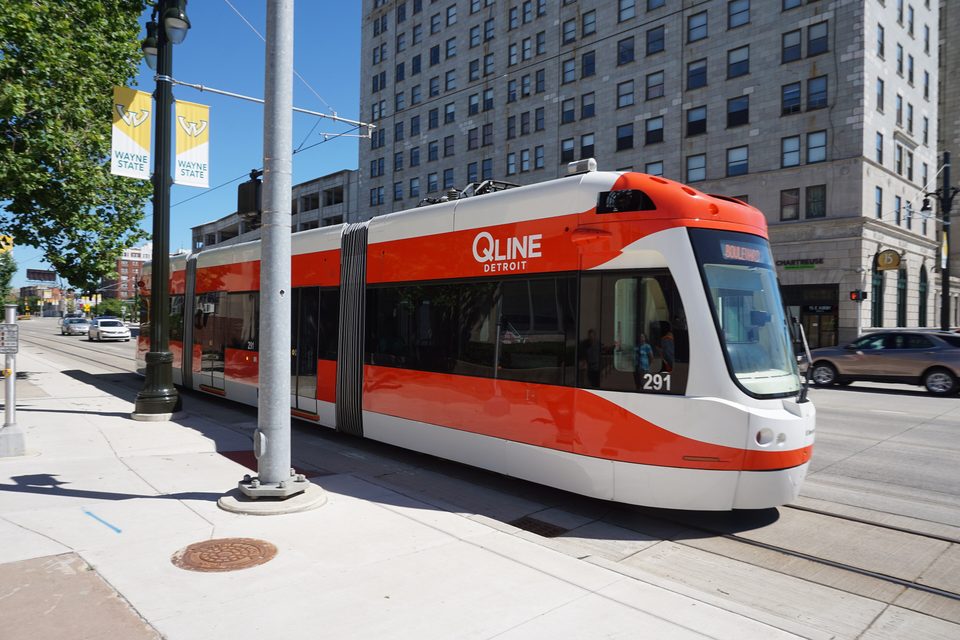
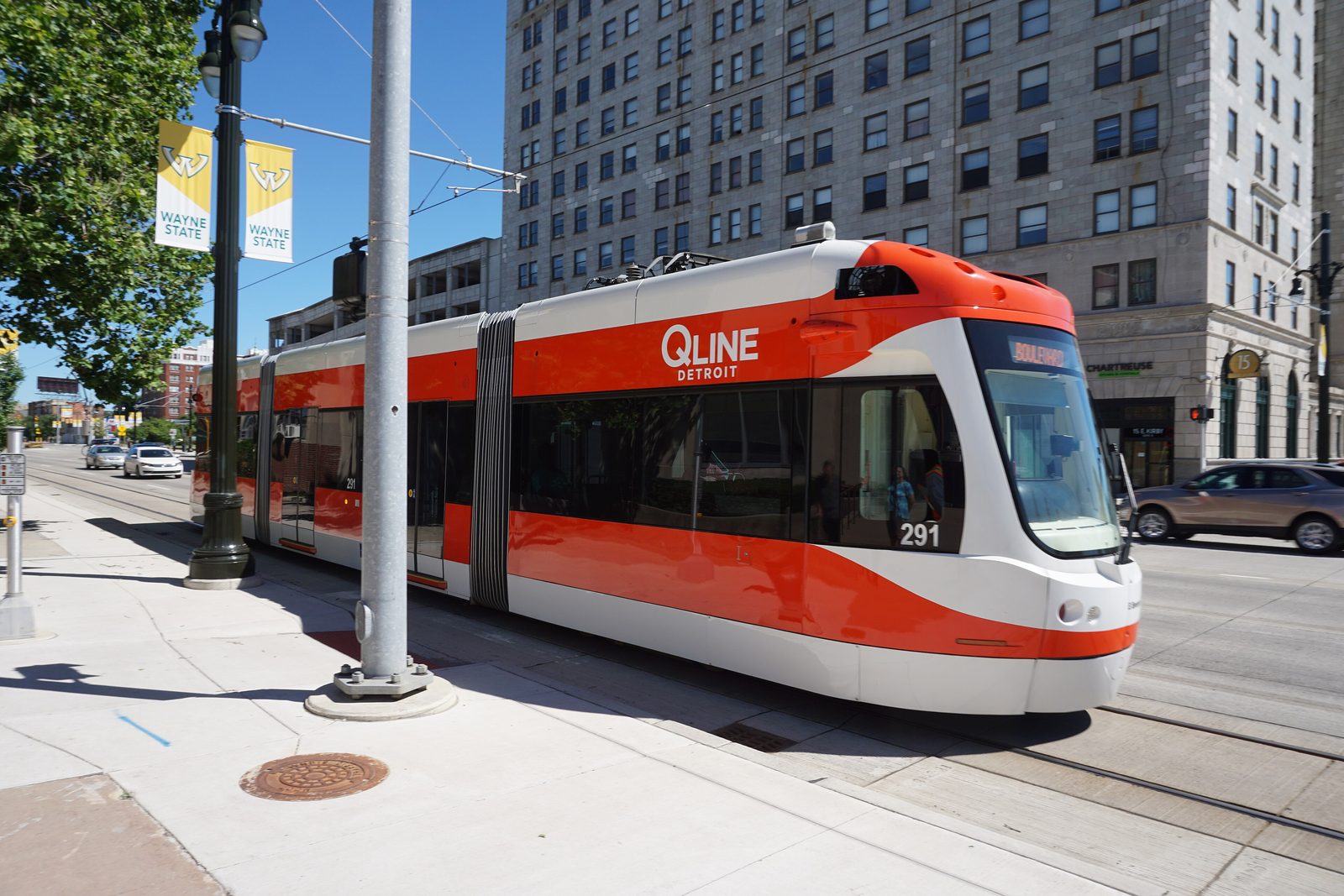
  8. Car 291 in Midtown among Wayne State University banners (2018)
    Michael Barera · CC BY-SA 4.0

    Stop 8 of 12

    Warren Avenue

    Two minutes on and you’re under the wire again. On your left the tower of the Maccabees Building, owned by Wayne State; on your right the Gothic bulk of the Cathedral Church of St. Paul. Ahead, the Detroit Institute of Arts’ white marble facade comes into view.

    The stop’s full story ↗
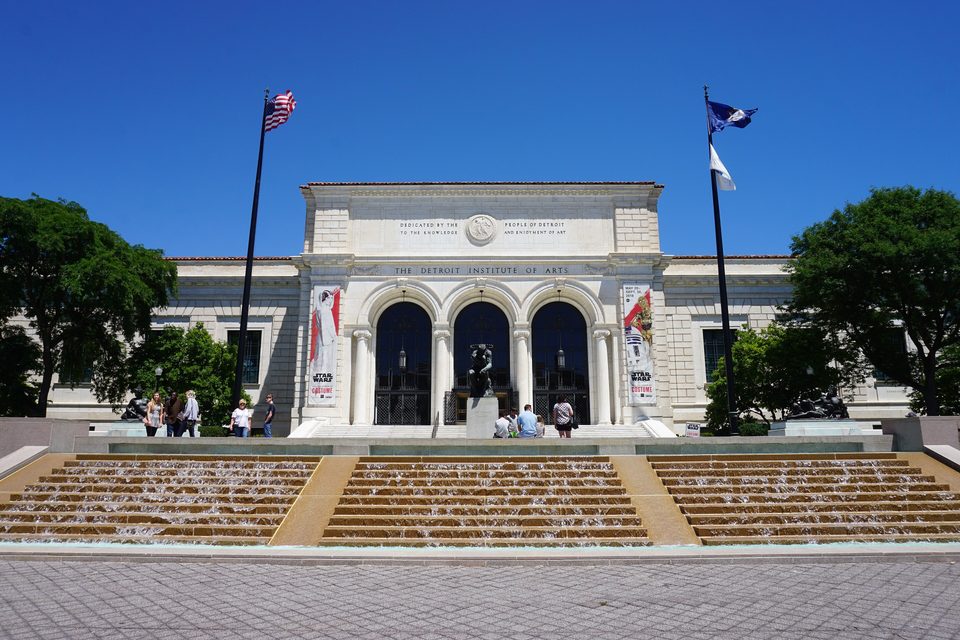
  9. The Detroit Institute of Arts’ Woodward entrance (2018)
    Michael Barera · CC BY-SA 4.0

    Stop 9 of 12

    Ferry Street

    Two minutes through the heart of the museum district. On your right the white marble palace of the Detroit Institute of Arts; on your left the Detroit Public Library, then the Detroit Historical Museum. The wired section ends at Ferry Street: north of here the streetcar runs mostly on battery.

    The stop’s full story ↗
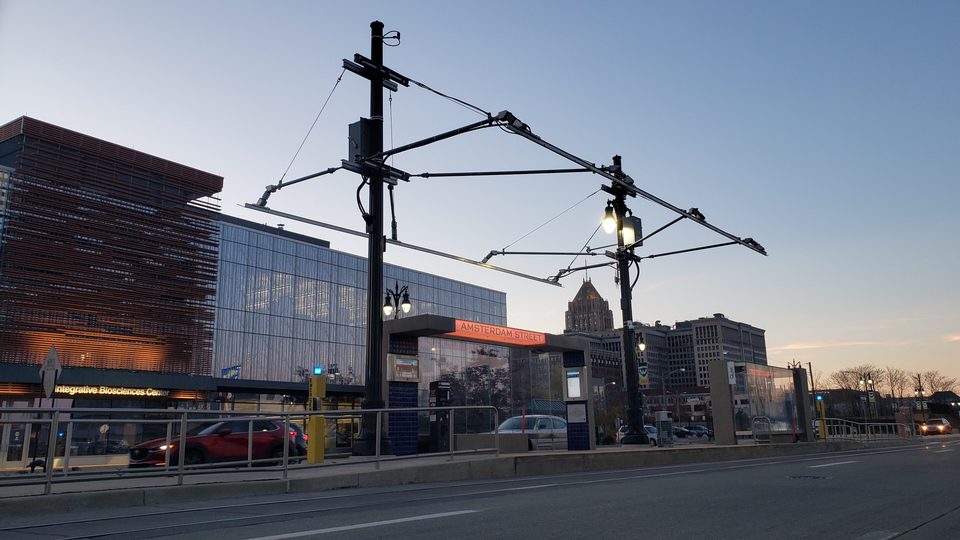
  10. The Amsterdam Street stop (2022)
    42-BRT · CC BY-SA 4.0

    Stop 10 of 12

    Amsterdam Street

    Two minutes: the streetcar crosses the I-94 freeway into New Center. At Amsterdam Street the tracks move to the middle of Woodward, and the stop becomes a single center platform for both directions. To the right, toward Milwaukee Junction, is Ford’s Piquette Avenue Plant, where the first Model T was built in 1908.

    The stop’s full story ↗
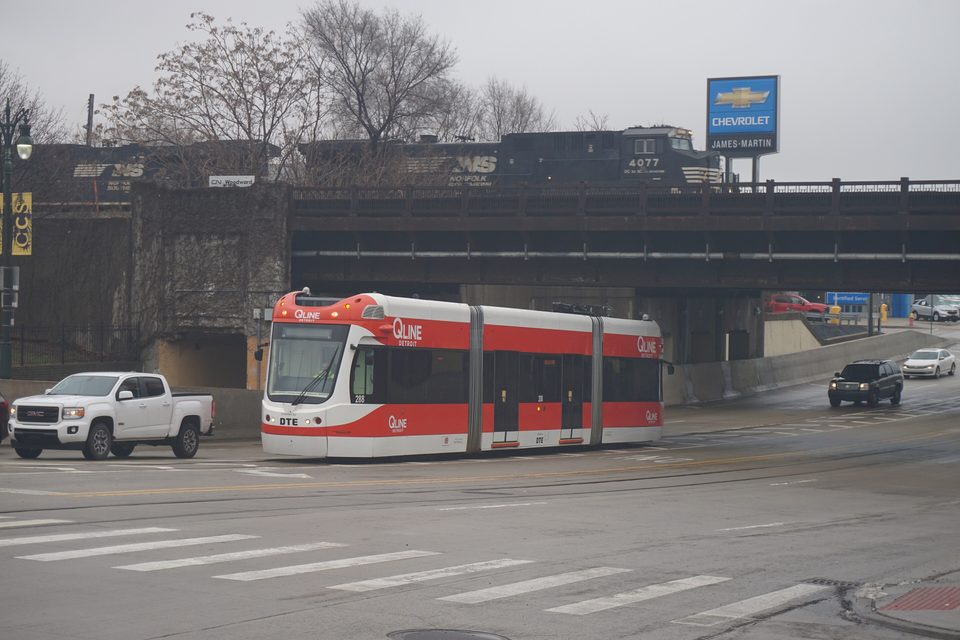
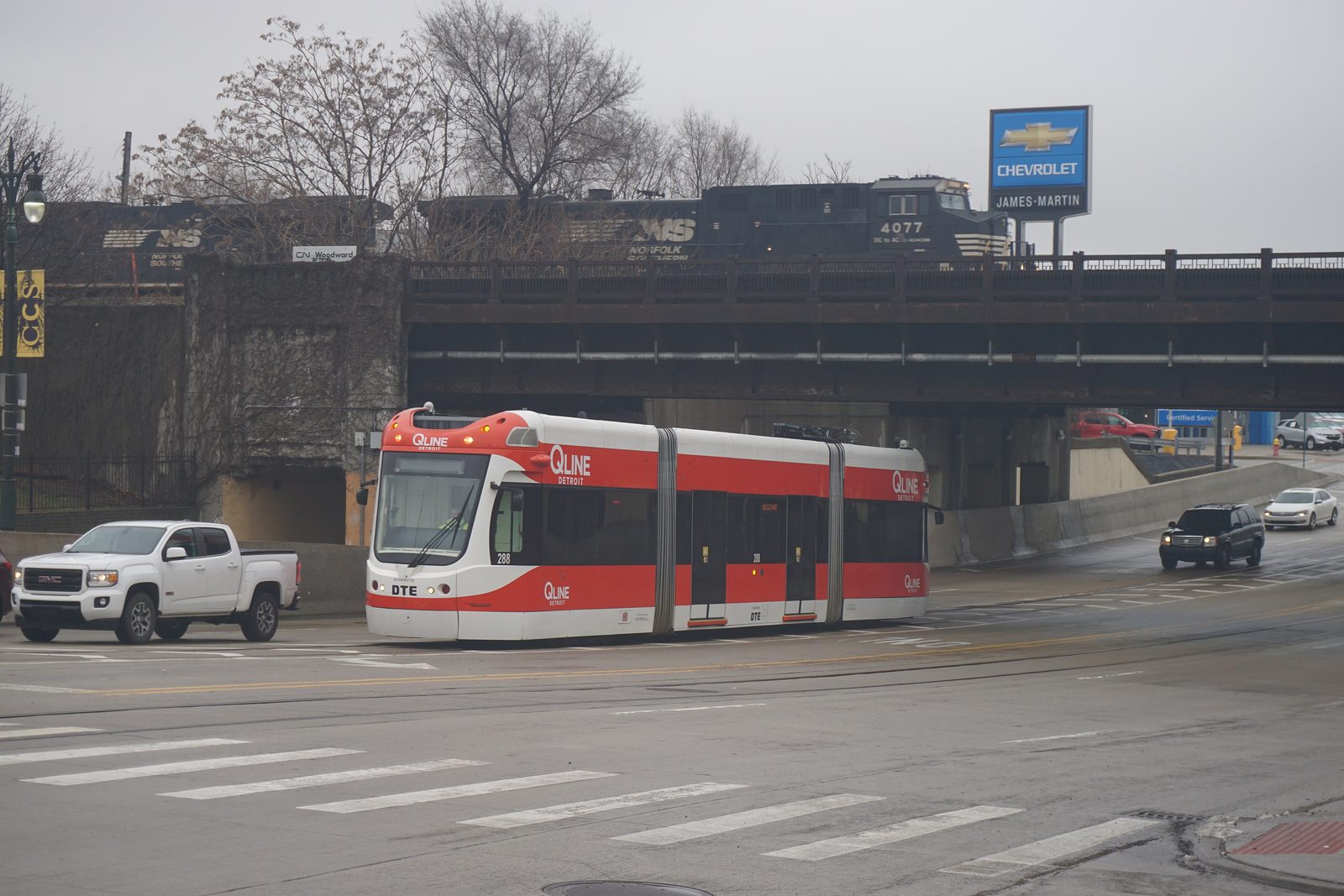
  11. A streetcar beneath the railway bridge as a Norfolk Southern freight passes above (2021)
    Michael Barera · CC BY-SA 4.0

    Stop 11 of 12

    Baltimore Street

    One minute: the streetcar ducks under the railway bridge, where Amtrak’s Wolverine trains and freight trains run overhead, and stops at the Baltimore Street center platform. On your left, at the corner, Detroit’s Amtrak station; a little farther on, GM’s former research laboratory, the Argonaut Building, now the College for Creative Studies’ design school.

    The stop’s full story ↗
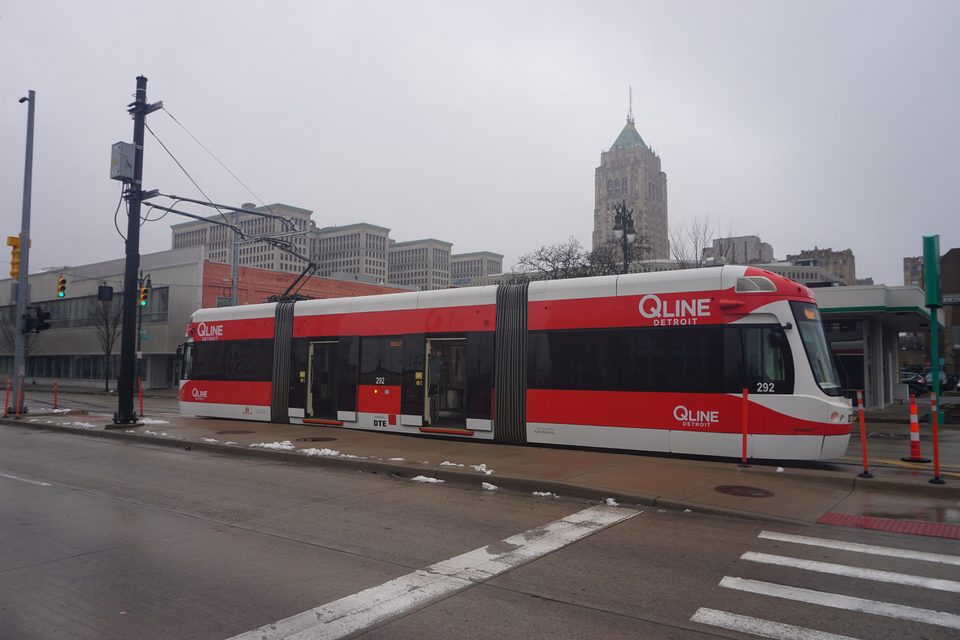
  12. Car 292 in New Center, with the Fisher Building’s tower behind (2021)
    Michael Barera · CC BY-SA 4.0

    Stop 12 of 12

    Grand Boulevard

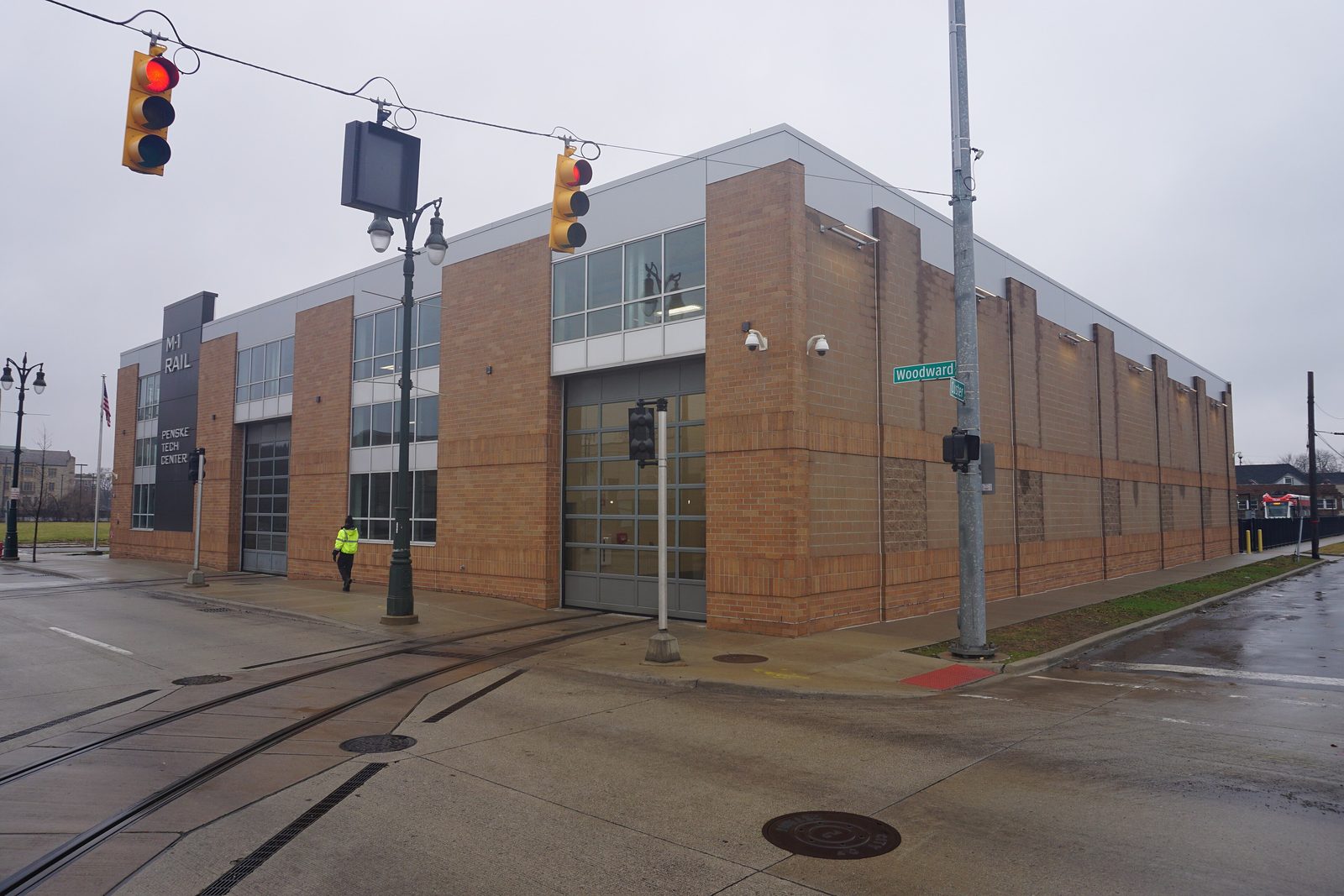
    One minute, and that’s the end of the line: the Grand Boulevard center platform is the QLINE’s northern terminus. On your left, along West Grand Boulevard, the Fisher Building and Cadillac Place, the two giants of New Center. The tracks carry on two more blocks to the Penske Tech Center, where the streetcars spend the night, and this car heads back to the river from here.

    The stop’s full story ↗

The virtual ride runs twenty-four times faster than the real trip.

04 / Stops

12 stops, each one a gateway

South to north, from the Detroit River to New Center. Every stop has its own page with its story, live departures and what to see nearby.

  1. Congress Street

    The riverside terminus: two blocks from the Detroit River, and the streetcar heads north from here.

  2. Campus Martius

    The city’s zero point: Detroit’s Mile Roads, 8 Mile included, are measured from here.

  3. Grand Circus

    The half-moon park where you can switch to the People Mover, and where the first riders climbed aboard in 2017.

  4. Montcalm Street

    The heart of Foxtown: the Fox Theatre’s marquee, with the Tigers’ ballpark across the street.

  5. Adelaide / Sproat

    The Little Caesars Arena stop, with two separate platforms and Detroit’s first red transit lane.

  6. MLK / Mack

    One crossing, two names: Martin Luther King to the west, Mack to the east. Next door, the Detroit Symphony’s hall.

  7. Canfield Street

    Eat, drink, bowl: the Majestic, America’s oldest bowling alley and MOCAD at one stop.

  8. Warren Avenue

    The gateway to Wayne State University and the museum district: the streetcar’s campus stop.

  9. Ferry Street

    Art, culture and history: the stop for the Detroit Institute of Arts and the Detroit Historical Museum.

  10. Amsterdam Street

    A center platform at the gateway to New Center, with park-and-ride next door and the Model T’s birthplace a nine-minute walk away.

  11. Baltimore Street

    Trains to Chicago, buses to Pontiac: the QLINE’s big transfer hub, at the Amtrak station.

  12. Grand Boulevard

    The northern terminus below the Fisher Building’s tower; the streetcars sleep two blocks away.

05 / Timeline

From horsecars to battery streetcars

Detroit rode streetcars for 93 years, then went 61 years without them. This is how rail came back to Woodward, with dates and sources.

1805–1956

Streetcars on Woodward

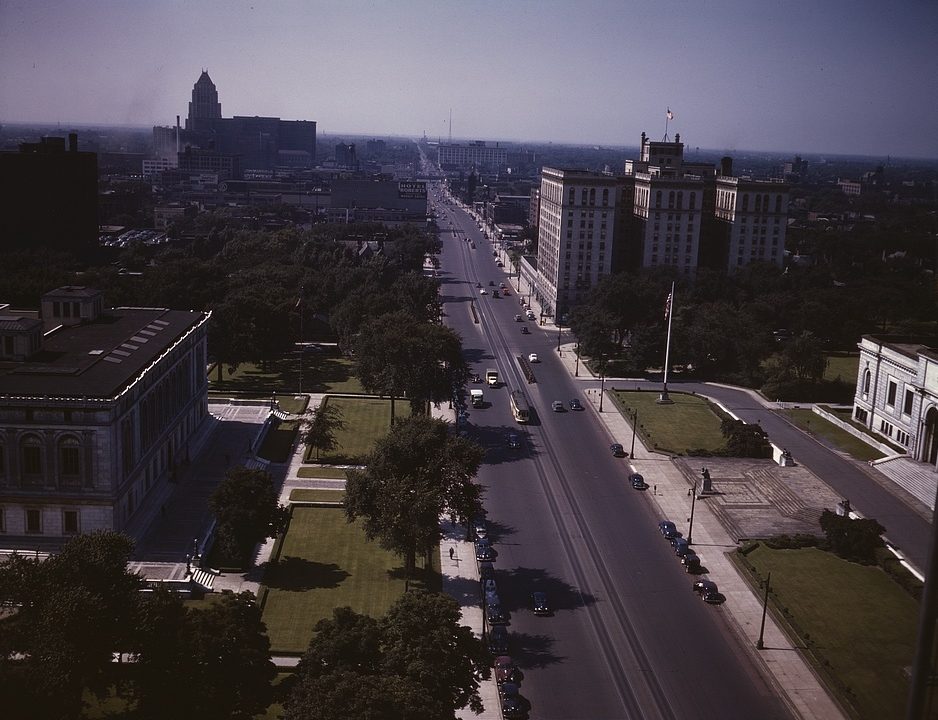
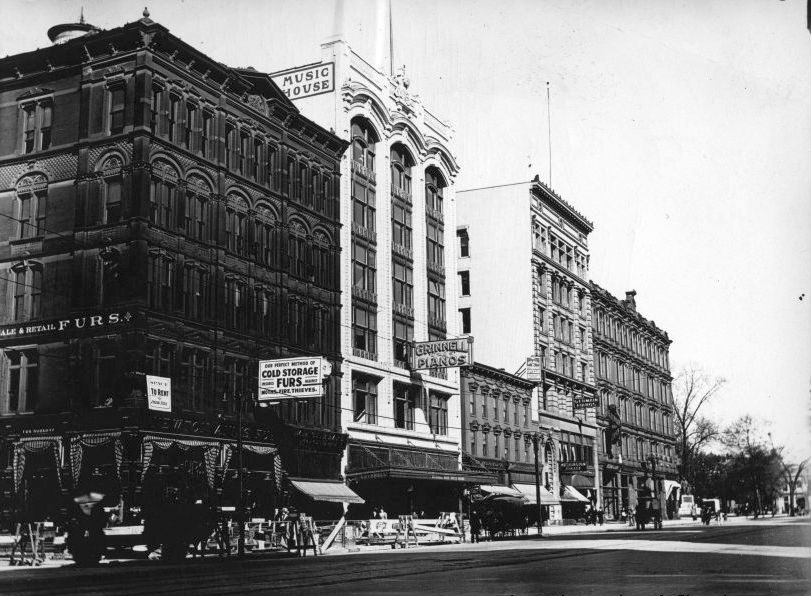
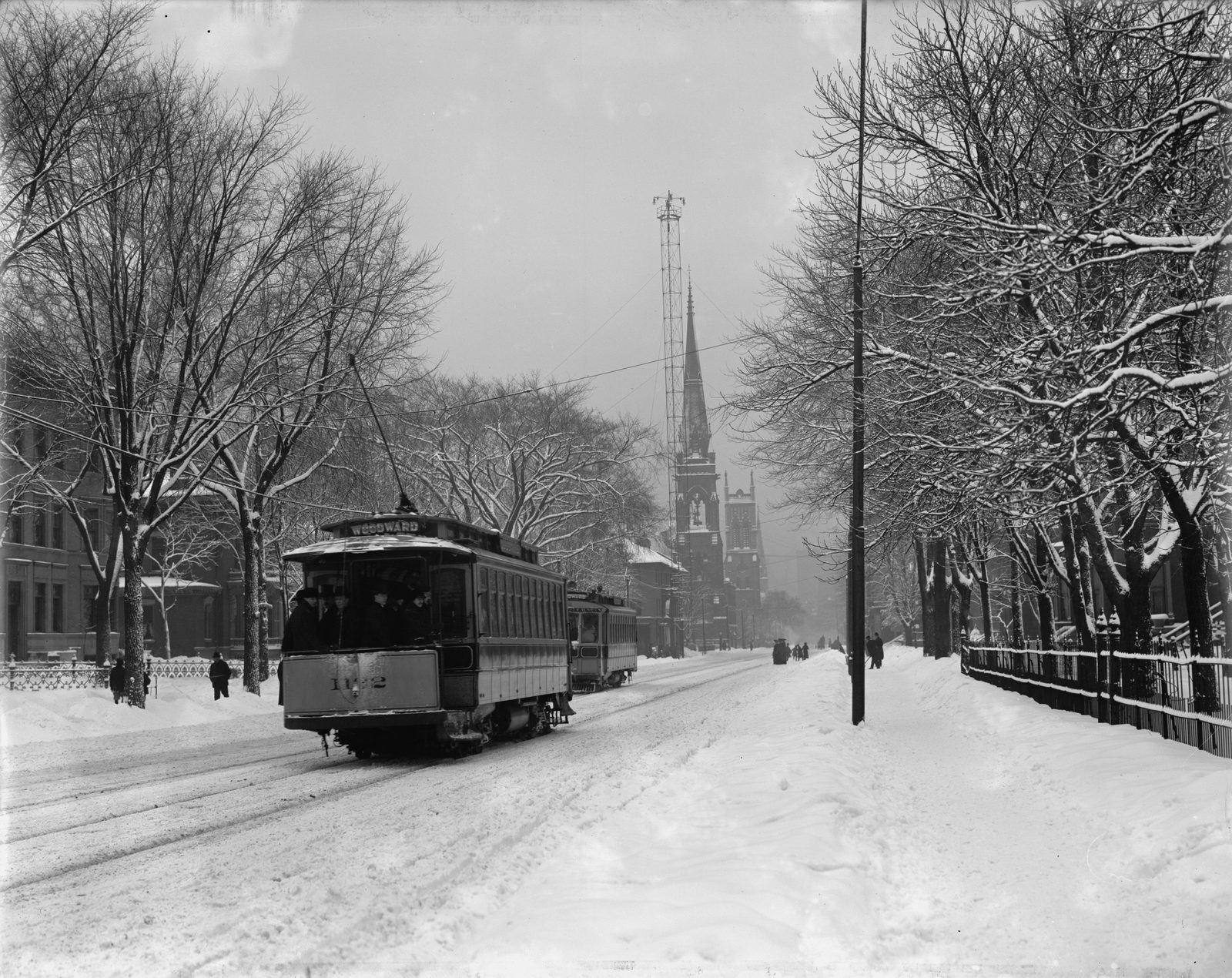
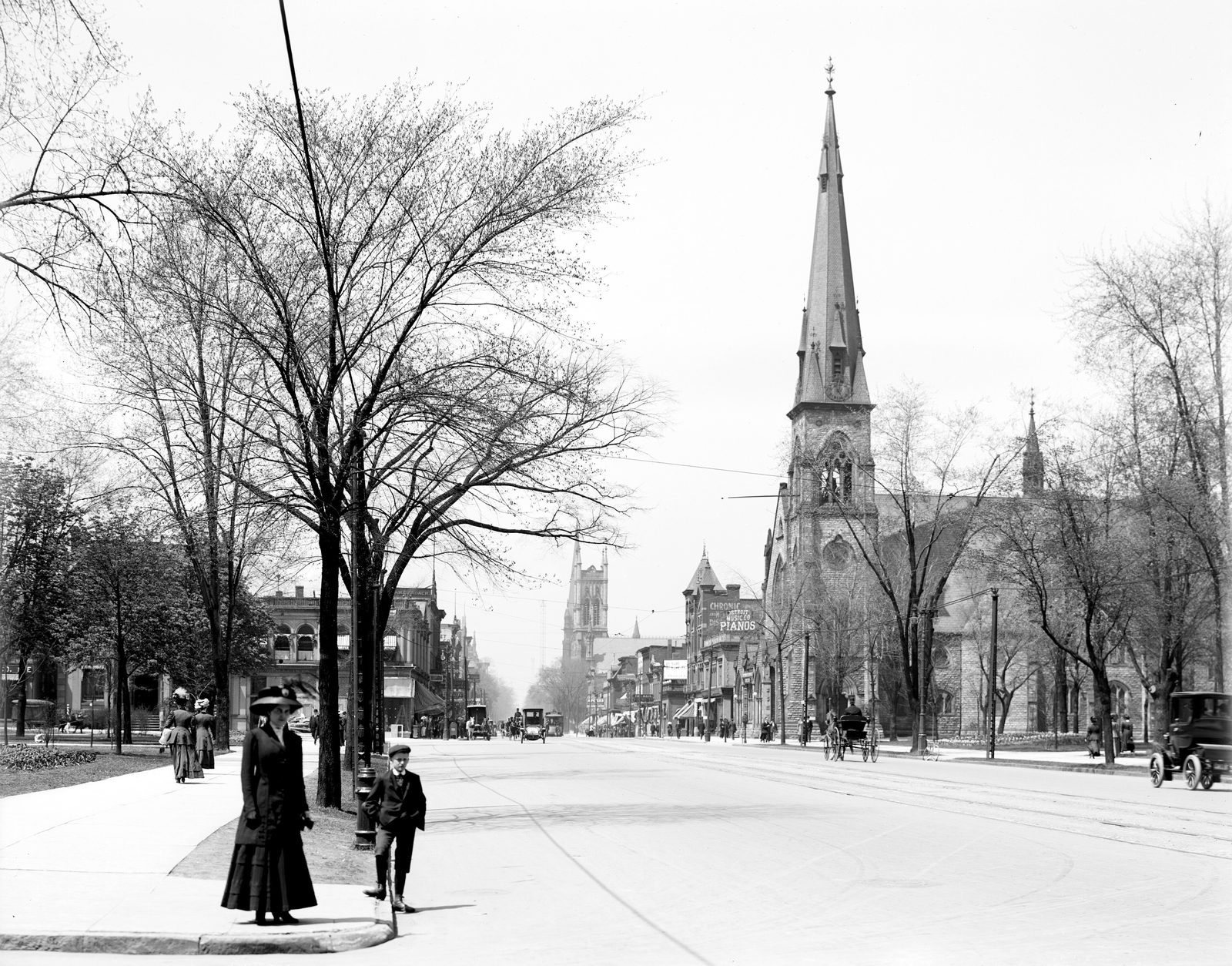
Horsecars ran on Detroit’s main street from 1863 and electric streetcars from 1886. By 1922 the city ran the largest municipally owned transit system in the country, and in 1956 the Motor City waved goodbye to its rails.

A streetcar on a snowy Woodward Avenue around 1900 (Detroit Publishing Co.)
A streetcar on a snowy Woodward Avenue around 1900 (Detroit Publishing Co.) · Detroit Publishing Co. · Public domain
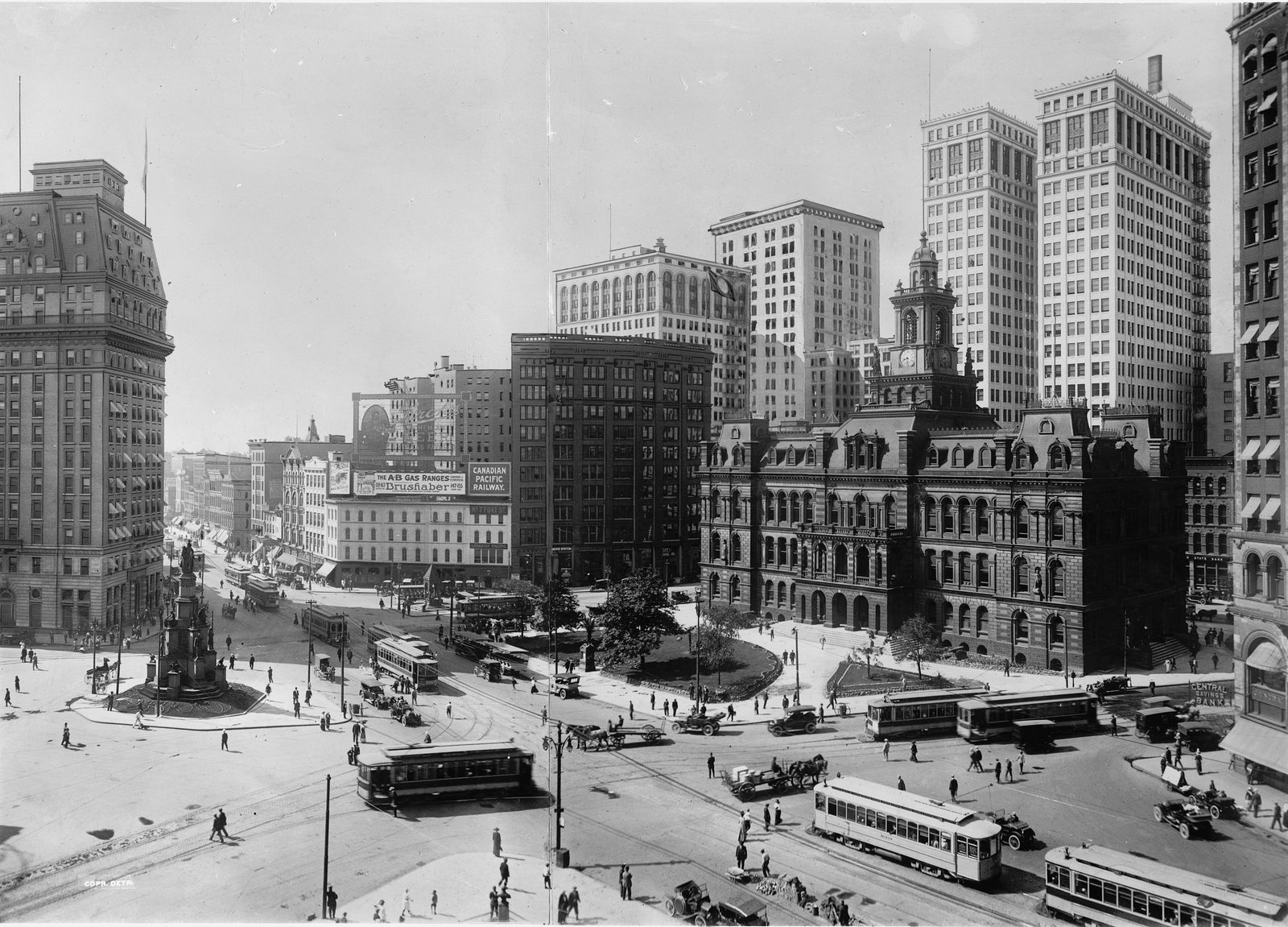
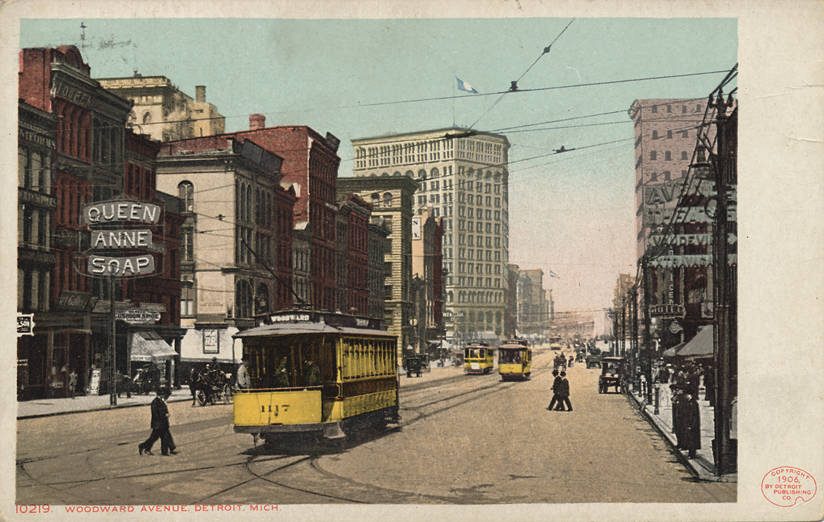
Woodward at Grand Circus Park around 1910 (Detroit Publishing Co.)
Woodward at Grand Circus Park around 1910 (Detroit Publishing Co.) · Detroit Publishing Company · Public domain
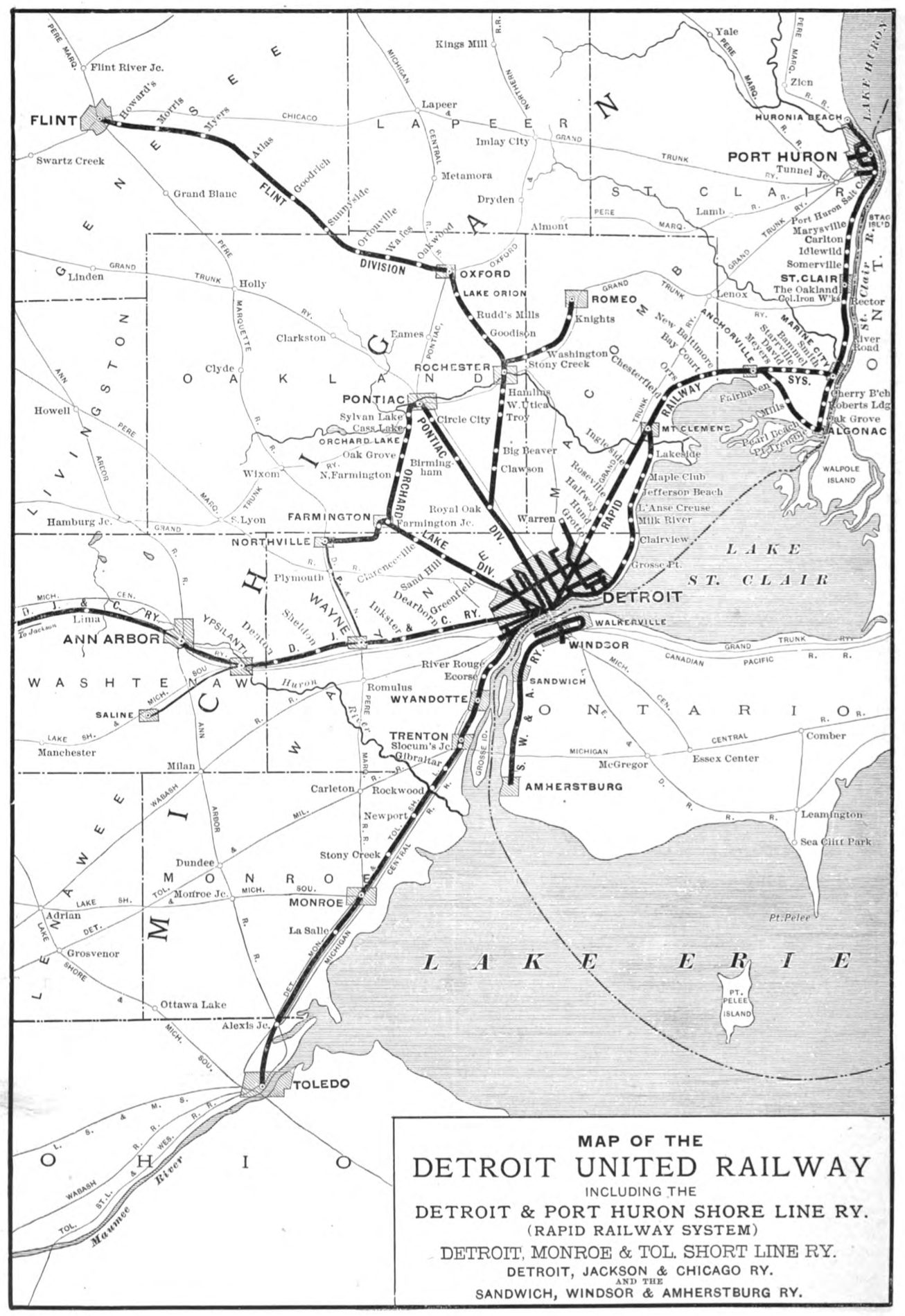
The Detroit United Railway network around 1907
The Detroit United Railway network around 1907 · American street railway investments. · Public domain
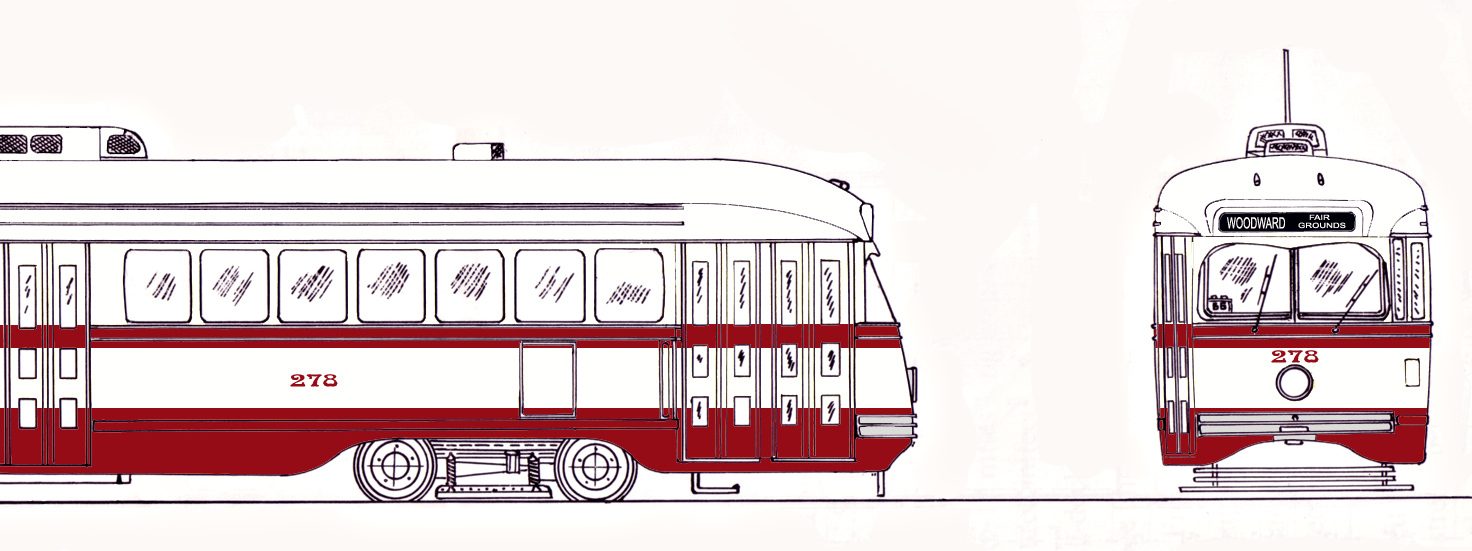
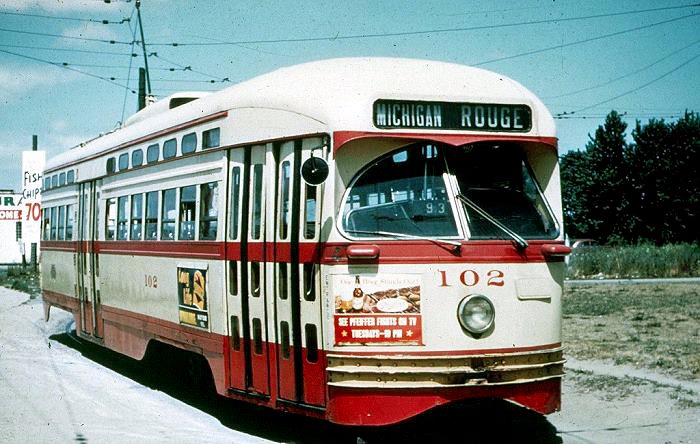
Detroit Department of Street Railways PCC car 102 on the Michigan–Rouge line (1950)
Detroit Department of Street Railways PCC car 102 on the Michigan–Rouge line (1950) · Voogd075 at Dutch Wikipedia · CC BY-SA 3.0
  1. A judge’s avenue

    After the great fire of 1805, Judge Augustus B. Woodward lays out a new street plan for Detroit. The main road running north from the river takes his name; the QLINE runs along it today.

    Wikipedia – M-1 (Michigan highway)

  2. Horsecars on Woodward

    On August 4 Detroit’s first horsecar line opens on Jefferson Avenue, and on August 27 horsecars start on Woodward, between Jefferson and Adams Avenue. The fare is five cents.

    Detroit Transit History – The Early Years

  3. The current arrives

    In September 1886 Detroit’s first electric streetcars start running, and on September 18 the Highland Park Railway brings them to the northern stretch of Woodward. The main Woodward line is electrified in December 1893, and the last horsecars disappear in November 1895.

    Detroit Transit History – The Early Years · Wikipedia – M-1 (Michigan highway)

  4. Detroit United Railway

    On December 31, 1900 four companies merge as the Detroit United Railway (DUR). By August 1901 the DUR controls nearly all the interurban lines as well, from Port Huron through Flint, Pontiac and Ann Arbor to Toledo.

    Encyclopedia of Detroit – Detroit United Railway

  5. The first concrete road

    The first mile of concrete road in the United States is laid on Woodward Avenue between 6 Mile and 7 Mile, for $14,000. The Motor City gets its first hard-paved highway.

    Wikipedia – M-1 (Michigan highway)

  6. The city’s own streetcars

    At 12:01 a.m. the city’s Department of Street Railways (DSR) takes over: about 363 miles of track, 4,000 workers and 1,457 streetcars, the largest municipally owned transit system in the United States. In 1923 the DSR’s streetcars carry 357,386,437 rides.

    Detroit Transit History – The City Takeover · Detroit Historical Society – Detroit’s streetcars, past and present

  7. The Journey’s End

    At 5:56 a.m. on Sunday, PCC car 223, the last scheduled streetcar on Woodward, pulls into the Woodward carhouse. That afternoon 24 cars parade up Woodward behind the Highland Park High School band; the last one, car 237, carries a banner reading “The Journey’s End”. After 93 years, Detroit’s streetcar era is over.

    Detroit Transit History – The last PCC years · Hour Detroit, 2012-05 – Back on Track (archived) · Detroit Historical Society – Detroit’s streetcars, past and present

  8. Streetcars for Mexico City

    After Philadelphia, San Francisco and Toronto pass, 183 nearly new PCC cars are sold to Mexico City for $699,000 in all, $3,000 to $4,000 apiece. The last car leaves on July 19.

    Detroit Transit History – The last PCC years

1957–2012

Plans and a heritage trolley

A subway plan, a small heritage trolley, then a Super Bowl that brought the city’s business leaders together. M-1 RAIL set out to build a streetcar with private money, and the larger public plan collapsed in 2011.

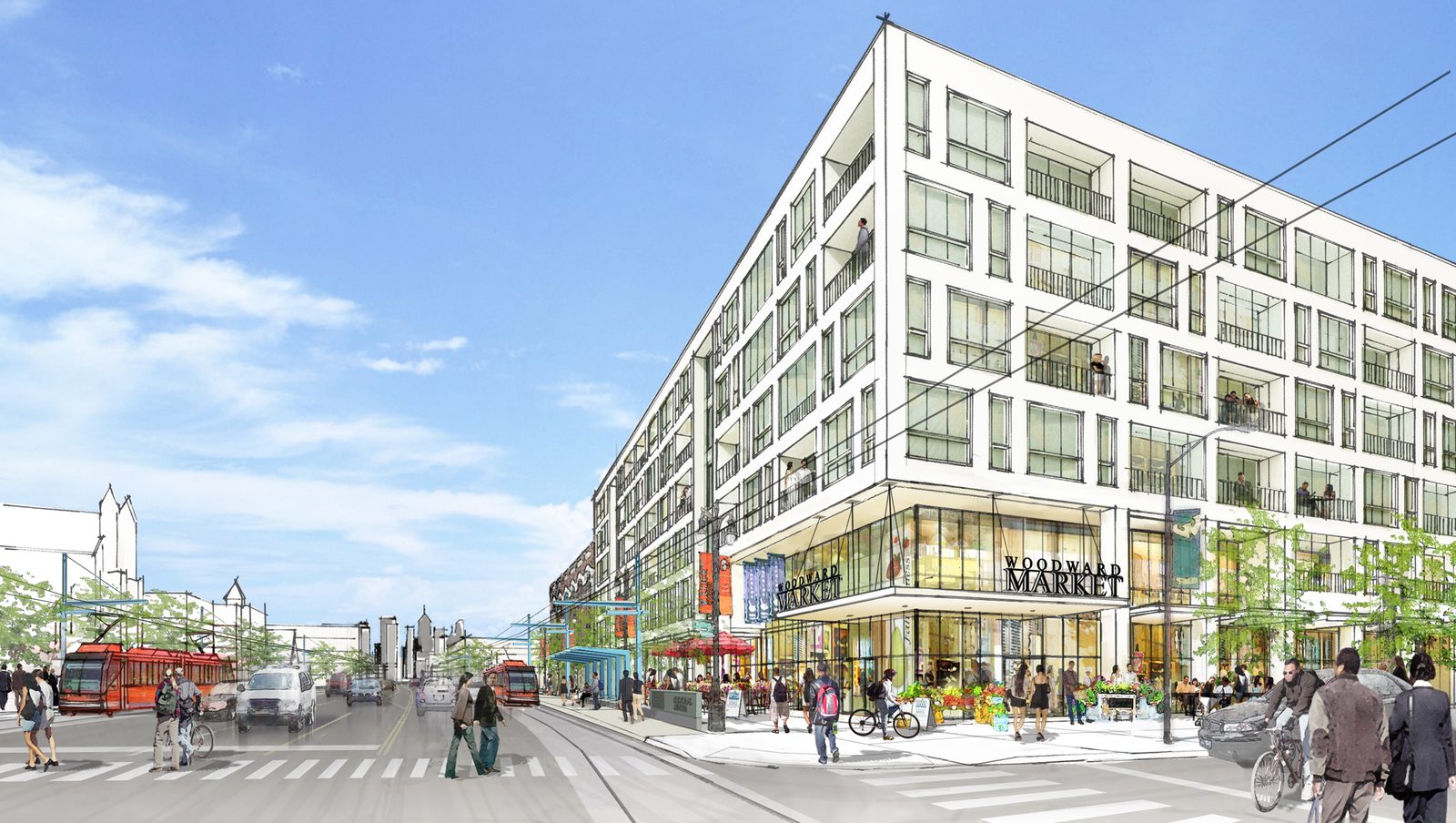
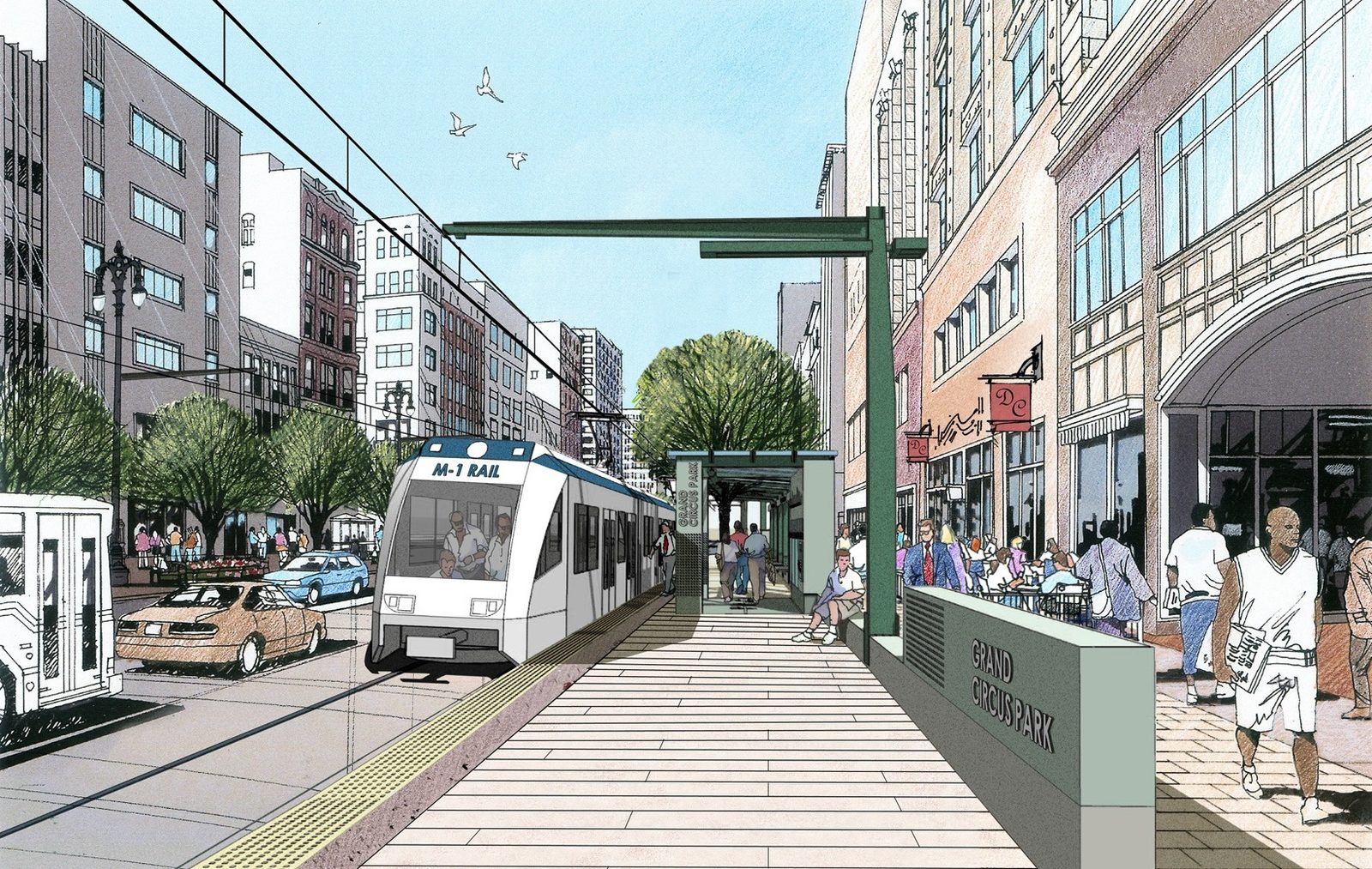
An M-1 Rail rendering of Woodward (2010)
An M-1 Rail rendering of Woodward (2010) · Eisbrenner Public Relations · Public domain
An early M-1 Rail station rendering (2012)
An early M-1 Rail station rendering (2012) · Eisbrenner Public Relations · Public domain
  1. A heritage trolley

    For the US Bicentennial the Detroit Downtown Trolley opens on Washington Boulevard between Grand Circus Park and Cobo Hall: 900-millimeter gauge, with vintage cars from Lisbon, Vevey in Switzerland and Burton upon Trent in England, including a double-decker. In 1980 it is extended to the Renaissance Center.

    Wikipedia – Detroit Downtown Trolley · Railway Preservation – Detroit’s vintage trolley

  2. The trolley bows out

    The Downtown Trolley makes its last run. Ahead of the 2006 Super Bowl the city redirects a grant of about $20 million to rebuild Washington Boulevard for cars, and the carhouse is demolished from February 2004.

    Wikipedia – Detroit Downtown Trolley · Railway Preservation – Detroit’s vintage trolley

  3. Super Bowl XL

    Detroit hosts Super Bowl XL. Roger Penske chairs the host committee, with Matt Cullen a key member. Soon after, Kresge Foundation president Rip Rapson and Penske talk about putting rail back on Woodward. The same year the city’s transit department, DDOT, begins studying rapid transit on Woodward.

    Kresge – Super Bowl XL and the creation of M-1 Rail · Woodward Light Rail – project overview (archived 2011)

  4. M-1 RAIL is formed

    Business leaders and foundations set up a non-profit to design, build and run a 3.3-mile streetcar on Woodward. The name comes from Woodward Avenue’s state highway number, M-1. Some sources give 2008 as the founding year.

    QLINE – About · Kresge, 2017-05-12 – Light rail in Detroit only the beginning · QLINE – History (archived 2018)

  5. The plan goes public

    Crain’s reveals the “Woodward Transit Catalyst Project”: a privately funded $103 million rail line between Hart Plaza and Grand Boulevard, with 12 stops and 1.8 million riders in year one. In March Penske takes civic leaders on study tours to Minneapolis, Portland and Denver.

    Crain’s, 2008-02-24 – Light-rail line for Woodward? (archived) · Kresge – Super Bowl XL and the creation of M-1 Rail

  6. Kresge’s $35 million

    The Kresge Foundation’s board approves an unprecedented $35 million grant for rail on Woodward (Kresge’s own history gives $34.6 million). It becomes the project’s lead gift and later grows beyond $50 million.

    Kresge, 2011-12-16 – Kresge remains committed to light rail · Kresge – Super Bowl XL and the creation of M-1 Rail · Kresge, 2017-05-12 – Light rail in Detroit only the beginning

  7. The big plan is cancelled

    M-1’s plan had merged with the city’s: the 9.3-mile, $528 million Woodward Light Rail would have run from downtown to 8 Mile Road. US Transportation Secretary Ray LaHood doubts Detroit could afford to run it, so Mayor Dave Bing and Governor Rick Snyder announce bus rapid transit instead. M-1’s backers return to their original, shorter streetcar.

    Kresge, 2011-12-16 – Kresge remains committed to light rail · LocalWiki Detroit – Woodward Light Rail · Crain’s, 2011-12-18 – M1 Rail back where it started (archived)

  8. A 1,200-page business plan

    At the end of a 90-day federal review, M-1 submits a business plan of about 1,200 pages. In June LaHood calls it a public-private partnership like no other in the nation’s history.

    Kresge, 2012-06 – M-1 Rail partners pledge to resolve last issues

  9. The RTA is born

    Governor Rick Snyder signs the regional transit authority act, creating the Regional Transit Authority of Southeast Michigan (RTA) for Wayne, Oakland, Macomb and Washtenaw counties. According to Rip Rapson, the legislature had failed two dozen times before to create one.

    Michigan Public Act 387 of 2012 – Regional transit authority act (archived PDF) · Kresge – How did Detroit and light rail appear in the same sentence? · Wikipedia – Regional Transit Authority of Southeast Michigan

2013–2017

Rails back on Woodward

Federal money, a Czech contract that fell through, battery cars from Pennsylvania, a name bought by a mortgage company, and on May 12, 2017, a streetcar on Woodward once more.

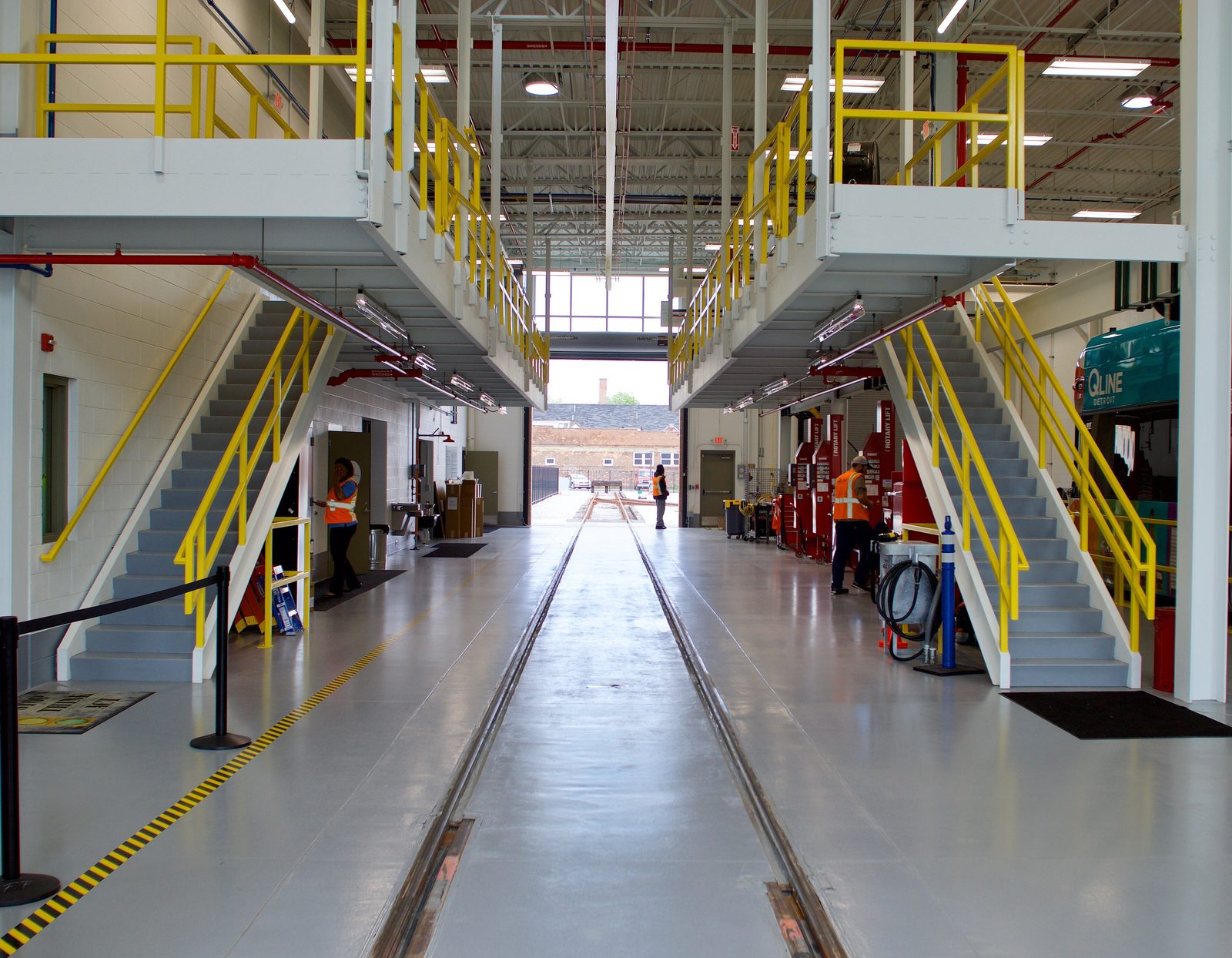
Inside the maintenance facility, May 2017
Inside the maintenance facility, May 2017 · A Healthier Michigan · CC BY-SA 2.0
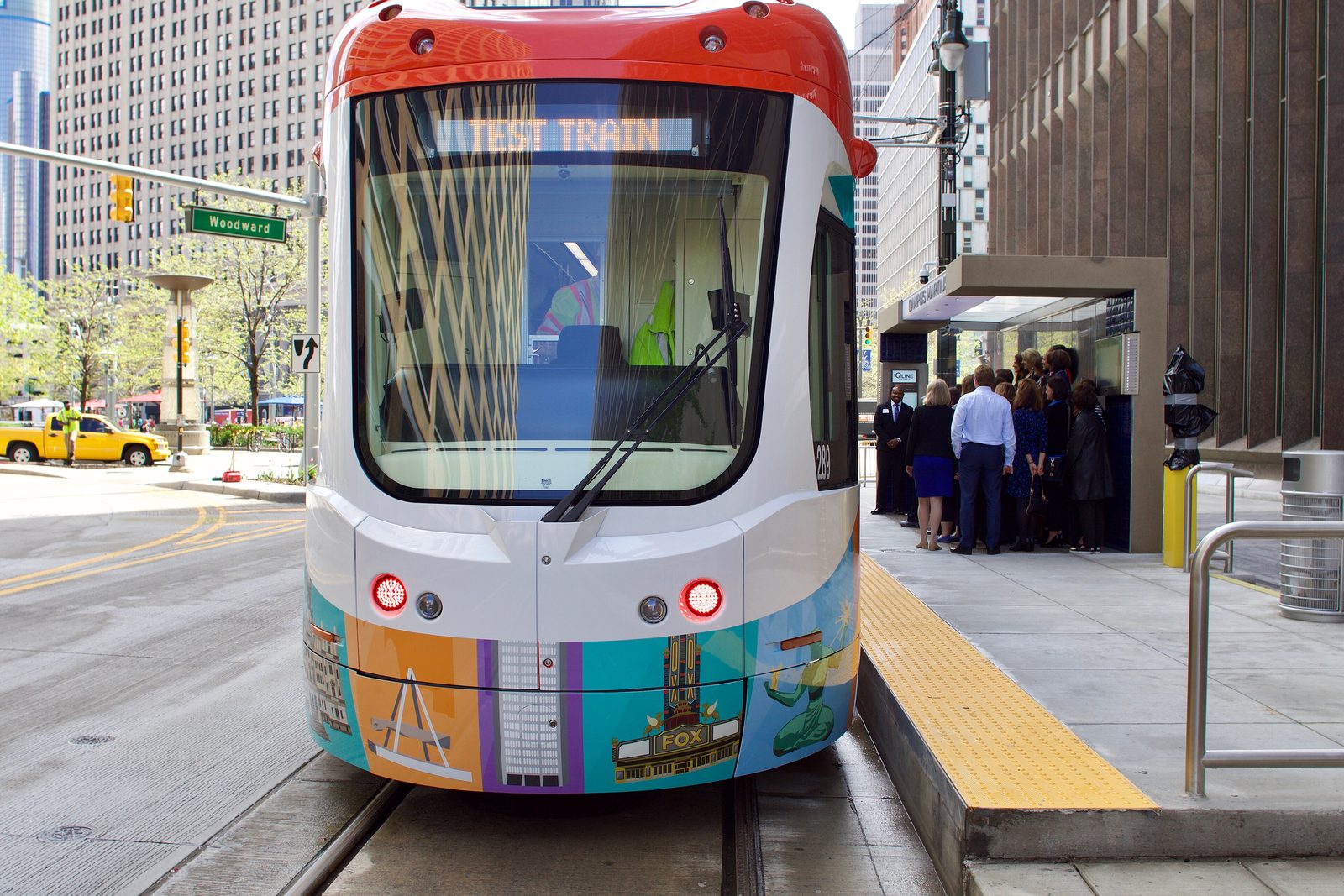
A test run at Campus Martius, eleven days before opening (May 2017)
A test run at Campus Martius, eleven days before opening (May 2017) · A Healthier Michigan · CC BY-SA 2.0
  1. $25 million from Washington

    Weeks after the RTA law, Ray LaHood announces a $25 million federal TIGER grant. “No other city in America has had their business community come together and raise $100 million,” he says. The project is then budgeted at $137 million.

    Kresge, 2013-01 – A $25 million federal grant puts M-1 Rail in motion · M-1 RAIL – QLINE Annual Report 2024 (PDF)

  2. A builder is chosen

    Stacy and Witbeck becomes construction manager. The funding: $35 million from Kresge, $3 million each from Dan Gilbert and Roger Penske, at least 15 organizations at $3 million apiece, $25 million in federal money, plus loans and tax credits. M-1 pledges to run the line for ten years and then hand it to the RTA. On December 20 utility relocation begins.

    Next City, 2013-07-02 – Laying the rails on Woodward Avenue · Wikipedia – QLine

  3. Groundbreaking

    Construction officially begins between Grand Circus Park and Campus Martius. “This is history,” says Mayor Mike Duggan. The work is scheduled for 27 months, the downtown stretch closes for 120 days, and the Woodward bridges over I-75 and I-94 are rebuilt wider.

    CBS Detroit, 2014-07-28 – History made as construction starts · Railway Gazette, 2014 – Detroit streetcar breaks ground (archived) · M-1 RAIL, 2014-07 – Woodward overpasses to be rebuilt (archived)

  4. A signed rail

    At Grand Circus Park US Transportation Secretary Anthony Foxx announces a further $12.2 million grant, and leaders sign a length of rail. New backers: DTE Energy with $3 million and Ford with the Amsterdam Street stop. Penske: “We are going to have a Super Bowl every day.”

    Michigan Chronicle, 2014-09-16 – Foxx announces $12.2 million (archived) · Wikipedia – QLine

  5. Czech cars that never came

    Czech firm Inekon is chosen to supply the six cars for about $30 million, but the deal falls through.

    Wikipedia – QLine

  6. A mortgage lender’s name

    Quicken Loans raises its pledge to $10 million and buys the line’s naming rights; it also sponsors the Congress Street stop.

    CBS Detroit, 2015-05 – Quicken Loans secures naming rights · Wikipedia – QLine

  7. Battery streetcars

    M-1 orders six Brookville Liberty streetcars from Brookville, Pennsylvania, for $32 million. They get 750-volt lithium-ion batteries, so they can run without overhead wire on 60 percent of the line. Chief operating officer Paul Childs says this spares the historic look of Woodward and keeps the maze of overhead wires away from the maintenance yard.

    The Detroit News, 2015-06-08 – M-1 Rail buying six off-wire streetcars (archived) · Brookville Equipment – M-1 Rail Detroit

  8. Slipping to 2017

    New federal safety rules and winter push the opening back to 2017.

    Wikipedia – QLine

  9. Its name is QLINE

    The name is announced: QLINE, pronounced “Q-Line”, with a stylized Q standing for connectivity. The Free Press reports that Quicken paid $5 million for the name, having also filed trademarks for RocketRail, Qlink, Quickline and Qride. The organization keeps the name M-1 RAIL.

    M-1 RAIL, 2016-03-24 – QLINE is the name of Detroit’s streetcar (archived) · Detroit Free Press, 2016-03-24 – M-1 Rail name announcement (archived)

  10. A depot without wires

    The $6.9 million, roughly 19,000-square-foot Penske Tech Center opens at 7520 Woodward, two blocks north of Grand Boulevard: headquarters, control room and workshop in one, in red brick to match the neighborhood. HNTB calls it the nation’s first streetcar maintenance facility to operate completely off-wire.

    Crain’s, 2016-05-02 – Penske Tech Center opens · Wikipedia – QLine · HNTB – QLINE streetcar

  11. Car 287 arrives

    In mid-September, about two months early, the first car arrives. It is numbered 287 because the last car of Detroit’s old streetcar fleet was 286; the six new cars carry the numbers 287 to 292.

    Crain’s, 2016-09-12 – First M-1 Rail streetcar arrives · MLive, 2016-09-21 – Inside Detroit’s first streetcar (archived)

  12. First roll-out

    The first car rolls out onto Woodward for a test, still under tow.

    Crain’s, 2016-12-13 – First QLine streetcar test run · Wikipedia – QLine

  13. All six cars delivered

    The last two cars arrive, on average 57 days ahead of contract according to Brookville. On March 9 the opening date is announced.

    Mass Transit, 2017-04 – Brookville completes QLINE delivery ahead of schedule · Wikipedia – QLine

  14. Streetcars on Woodward again

    A Friday ceremony with the Cass Tech band. Detroit resident Pat Baldwin cuts the ribbon, and Tanya Marshall is the first member of the public aboard: the first streetcar through the heart of Detroit in 61 years. Mayor Mike Duggan: “People thought getting rid of rail was progress … We all know we lost something special.” Nearly 50,000 people ride free in the first week.

    Detroit Free Press, 2017-05-12 – All aboard: the QLINE opens (archived) · CBS Detroit, 2017-05-12 – QLine grand opening · M-1 RAIL – QLINE Annual Report 2024 (PDF) · QLINE – History (archived 2018)

2017–2021

Learning years

A record opening, then fares, cars parked beside snowbanks and a debate over whom the line was built for. In spring 2020 the pandemic stopped the streetcar.

Car 291 in Midtown among Wayne State University banners (2018)
Car 291 in Midtown among Wayne State University banners (2018) · Michael Barera · CC BY-SA 4.0
An evening streetcar outside the Majestic and Garden Bowl (2018)
An evening streetcar outside the Majestic and Garden Bowl (2018) · Michael Barera · CC BY-SA 4.0
  1. A free summer

    Free rides are extended to May 21, then to July 1, and from July 1 to Labor Day the Kresge Foundation pays the fares. The opening weekend saw 8,300 riders a day, and August around 5,500.

    FOX 2 Detroit, 2017-05-19 – Free QLine rides extended to July 1 · The Detroit News, 2017-12-28 – QLine extending hours · Wikipedia – QLine

  2. The final bill

    Final construction cost is $144 million, $7 million over the earlier estimate, mainly for the technology behind longer battery running. Over a decade M-1 raised $187.3 million in all; the rest covers the first ten years of operation.

    Crain’s, 2017-08-28 – QLine cost $7 million higher than estimated

  3. Fares begin

    After Labor Day fares arrive: $1.50 for three hours, $3 a day, $30 a month, $285 a year. Daily ridership drops from about 5,000 to around 3,000, and roughly 40 percent of riders pay.

    Crain’s, 2017-09-05 – QLine begins charging riders · Crain’s, 2017-09-22 – 40% of QLine riders paying

  4. An award for the engineers

    Engineering News-Record gives the project an Award of Merit as the first major-city transit project to come from a public-private partnership.

    ENR Midwest, 2017-11 – Award of Merit: Detroit M1 Rail Streetcar

  5. Later nights

    The streetcar now runs until midnight Monday to Thursday, until 2 a.m. on Fridays and Saturdays and until 11 p.m. on Sundays, with seven new operators.

    The Detroit News, 2017-12-28 – QLine extending hours

  6. Who was the rail built for?

    A study by Joe Grengs and Kate Lowe finds that the curbside alignment was shaped by backers’ property interests, while public comments favored the center lane. In August Mayor Mike Duggan says that had he been mayor a year earlier, the streetcar would run in its own lane down the middle of the street.

    Metro Times, 2018-03-30 – Study: private interests steered QLine plans · Crain’s, 2018-08-26 – Duggan wants a dedicated QLine lane

  7. The first year in numbers

    Year one brings more than 1.3 million rides: 4,660 a day in the warm months and 2,700 in winter, short of the 5,000-a-day goal. Winter causes 267 service stoppages, many from cars parked beside snowbanks. The official report says the cars run off-wire 80 percent of the time.

    QLINE On The Move – one-year report (archived) · Michigan Public, 2018-05-01 – One year in, Detroit’s QLine

  8. One ticket, three operators

    The QLINE joins Dart, the shared fare system of DDOT and SMART: a four-hour regional pass for $2, a 24-hour pass for $5, with transfers to the buses.

    WXYZ, 2019 – QLINE modifying fares to match the bus systems · WDET, 2019-10-07 – QLINE tickets can now be used on the bus

  9. The streetcar stops

    Because of the pandemic, service stops at 8 p.m. on Sunday. The cars still roll out now and then for maintenance, but carry no passengers for 18 months.

    WDIV, 2020-03-27 – QLINE will suspend operations · Crain’s, 2021-02-15 – QLine plans a late-summer restart

  10. In-house

    From January Lisa Nuszkowski, founder of the MoGo bike share, is M-1’s president. In February it emerges that M-1’s own team, not Transdev, will run the streetcar.

    Crain’s, 2021-02-15 – QLine plans a late-summer restart

2021–2024

Free and recharged

An in-house team, free rides, a red lane, a tow truck of its own and state funding to 2039. In 2023 it topped a million riders for the first time, and in 2024 the daily record fell.

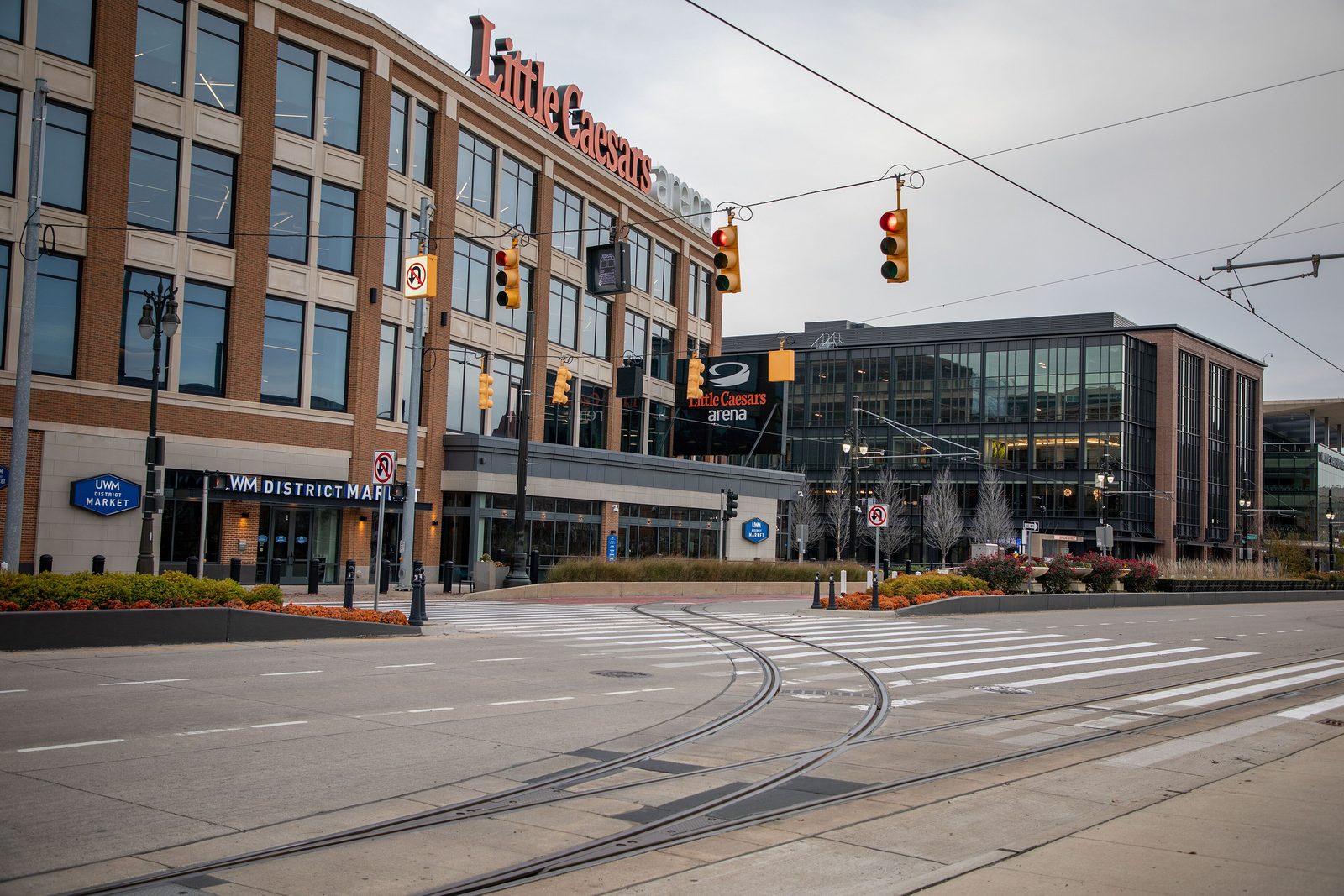
The tracks curving near Little Caesars Arena (2021)
The tracks curving near Little Caesars Arena (2021) · Bluediamond616 · CC BY-SA 4.0
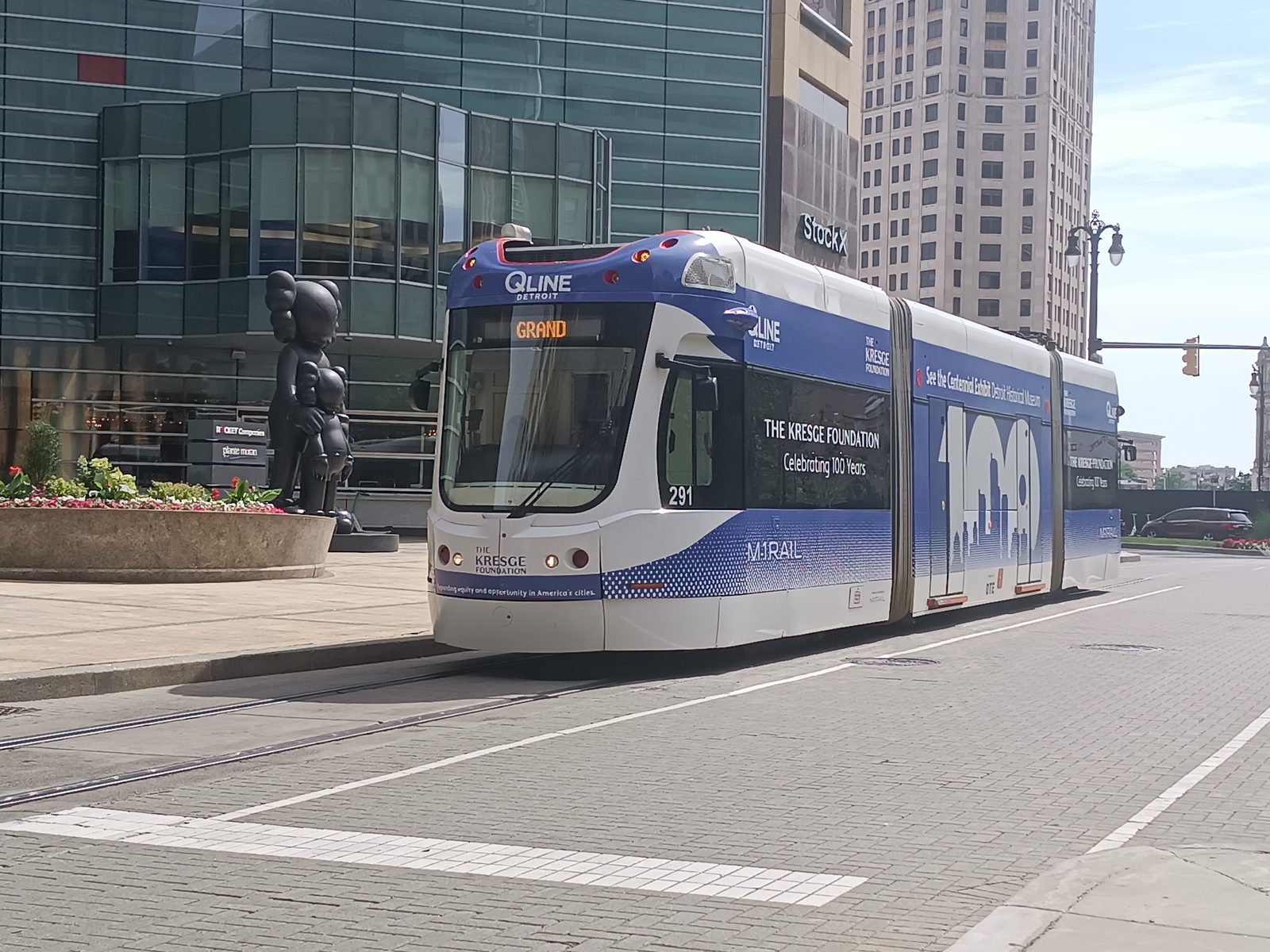
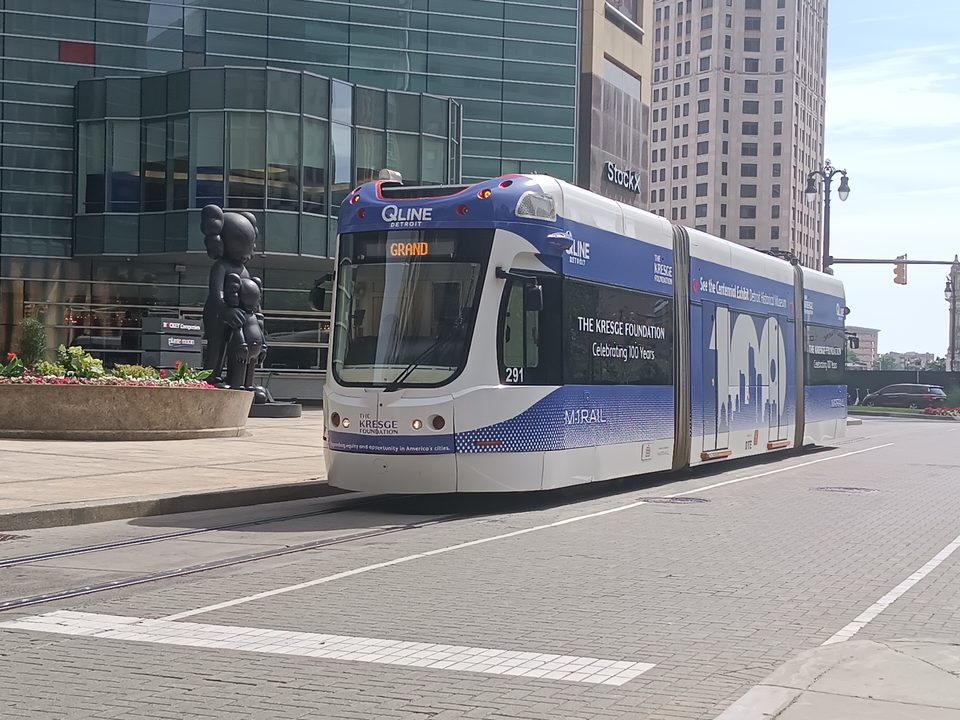
Car 291 in the Kresge Foundation’s 100th-anniversary wrap downtown (2024)
Car 291 in the Kresge Foundation’s 100th-anniversary wrap downtown (2024) · Kyah117 · CC BY 4.0
  1. A red lane

    In front of Little Caesars Arena, the southbound curb lane between Temple Street and the I-75 service drive is painted red and marked “Transit Only”: Detroit’s first transit-only lane, shared by the QLINE and DDOT and SMART buses.

    Detroit Free Press, 2021-09-18 – Transit-only lane at Little Caesars Arena

  2. Back, and free

    Preview runs carry visitors during the DLECTRICITY light festival on September 24 and 25, and on Monday scheduled service returns after 18 months: run in-house and free of charge. From September Rachel Schmuhl is the line’s general manager.

    WDIV, 2021-09-23 – QLINE returns September 27 with free rides · QLINE – About · M-1 RAIL – QLINE Annual Report 2024 (PDF)

  3. Free, with no end date

    Free rides, extended in December to April, now continue with no planned end, backed by Penske and Kresge, and a discount program with businesses along the line begins.

    WDIV, 2021-12-16 – QLINE free until April 2022 · The Detroit News, 2022-03-30 – Free QLine rides continue

  4. A tow truck of its own

    Longer hours: until midnight Monday to Saturday and until 9 p.m. on Sundays. With a donated tow truck, M-1 now removes cars parked on the tracks itself; the official site says a badly parked car delays the streetcar by 27 minutes on average.

    The Detroit News, 2022-06-15 – QLine hours extended · QLINE Detroit – official site

  5. Green lights

    Transit signal priority is added at 26 intersections on Woodward. An end-to-end trip now averages 23 minutes, down from 26 to 28 minutes in 2019.

    Crain’s, 2022-11 – QLine ridership up as service improves

  6. Free to 2039

    Governor Gretchen Whitmer signs Public Act 276 of 2022 (Senate Bill 1223): up to $5 million a year from the convention facility fund, fed by hotel and liquor taxes, goes to the streetcar’s operator until September 30, 2039. That is about half the operating cost, and it keeps the rides free.
    Michigan Legislature – Senate Bill 1223 of 2022 · The Detroit News, 2022-12-29 – Whitmer signs QLine subsidy

  7. The Taylor Swift effect

    During Taylor Swift’s concerts at Ford Field the streetcar carries 5,500 riders a day.

    BridgeDetroit, 2023-06-28 – The QLine’s limitations

  8. Over a million

    2023 brings 1,003,975 rides: more than a million in a year for the first time, 50 percent up on 2022. In December the RTA proposes to take over the line.

    M-1 RAIL – QLINE Annual Report 2024 (PDF) · QLINE, 2024-01-30 – 1 million riders in 2023 · BridgeDetroit, 2023-12-15 – Shift in QLine management

  9. Pure Michigan on board

    The Michigan Strategic Fund forgives M-1’s remaining $3.5 million loan; in return the state may wrap the cars and run Pure Michigan promotions on the 20 platform screens until 2028.

    The Detroit News, 2024-03-26 – State forgives $3.5M QLine loan · M-1 RAIL – QLINE Annual Report 2024 (PDF)

  10. A record at the NFL Draft

    68,377 riders in three days and 24,693 on day one alone, 272 percent above the previous record of 9,095 from 2017. Nearly 9 percent of the Draft’s 775,000 visitors took the streetcar, and four cars wore special Draft wraps.

    M-1 RAIL – QLINE Annual Report 2024 (PDF) · QLINE, 2024-05-07 – Ridership record during the NFL Draft

  11. Park and ride

    On May 20 a park-and-ride pilot with Wayne State University starts beside the Amsterdam Street stop. In May the Chevrolet Detroit Grand Prix wraps the downtown stops, and in June the cars are wrapped for the Kresge Foundation’s 100th anniversary.

    QLINE, 2024-05-20 – Park and ride pilot with Wayne State · M-1 RAIL – QLINE Annual Report 2024 (PDF)

2024–2026

The region’s streetcar

On October 1, 2024 the QLINE passed to the Regional Transit Authority, fulfilling the founders’ promise that a line built with private money would end up in public hands.

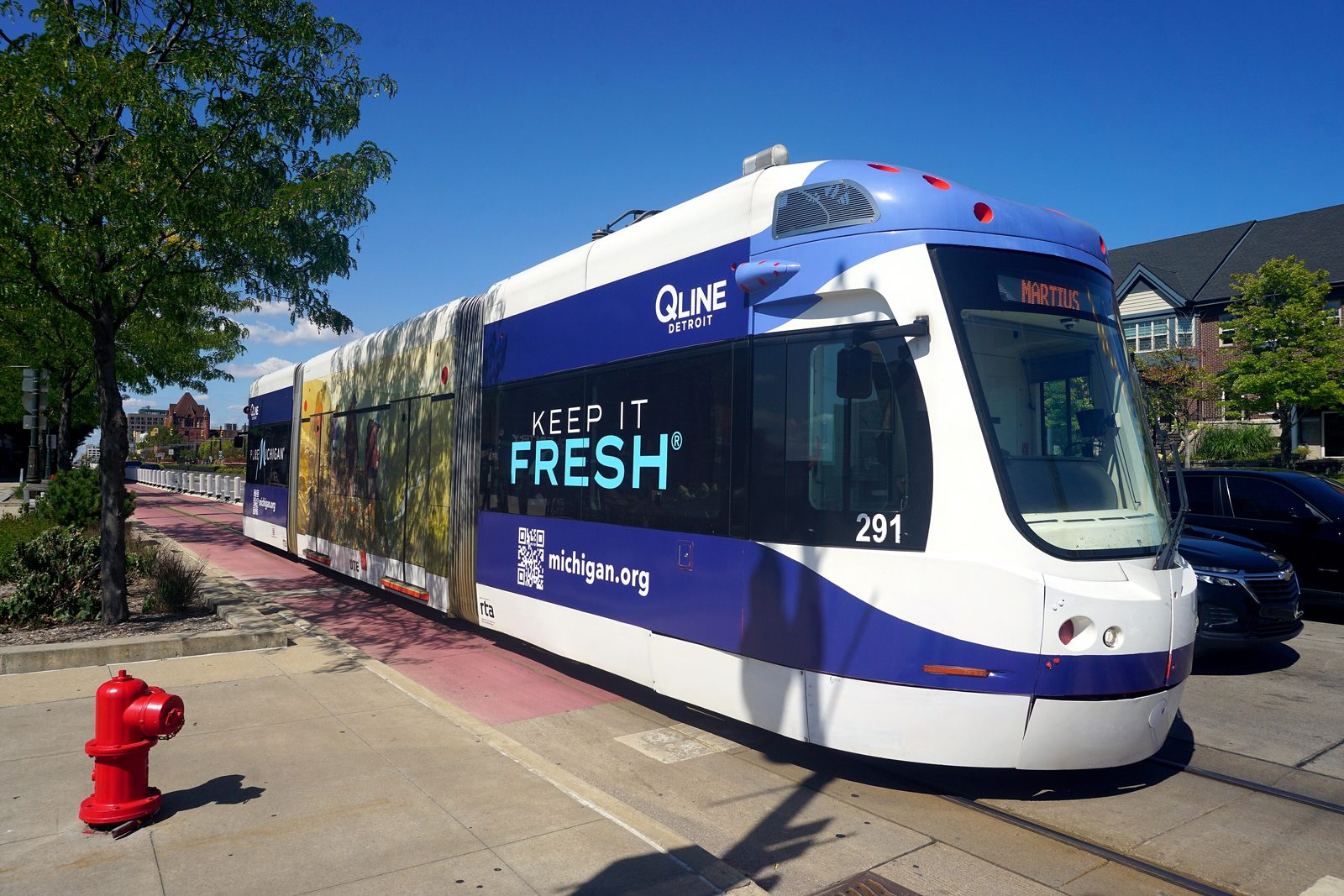
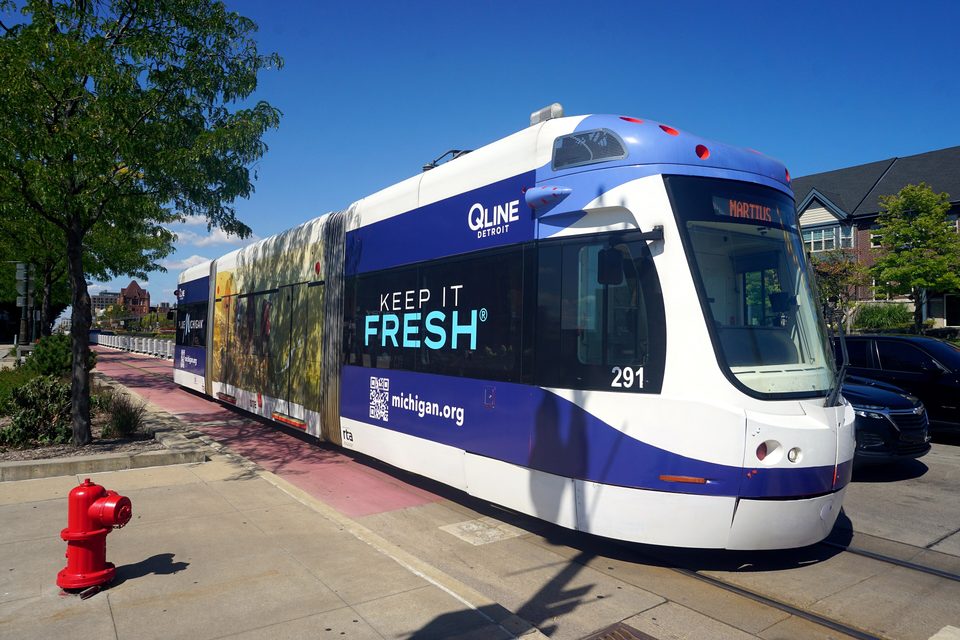
“Keep it Fresh” – car 291 in a Pure Michigan wrap (2025)
“Keep it Fresh” – car 291 in a Pure Michigan wrap (2025) · Michael Barera · CC BY-SA 4.0
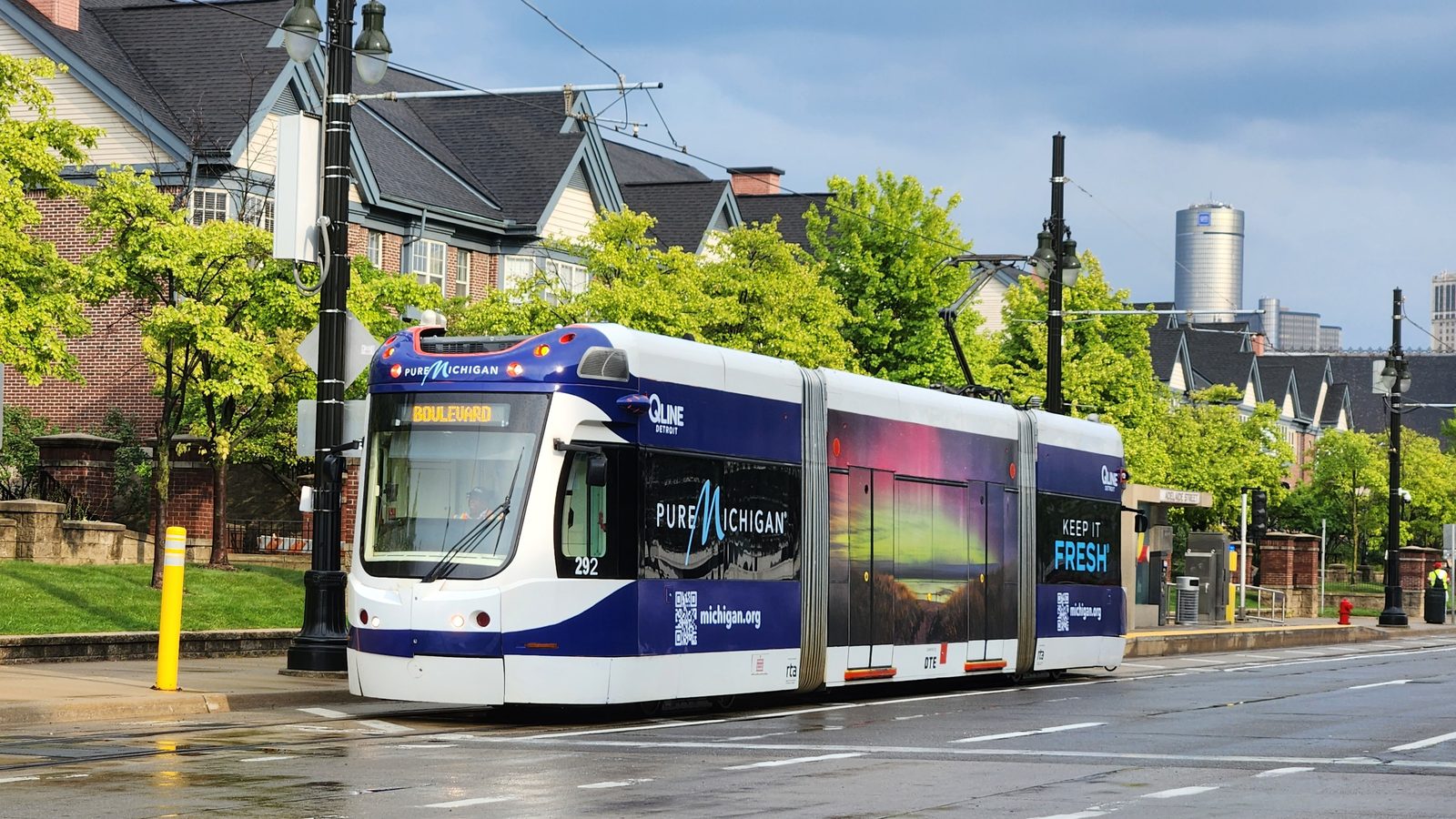
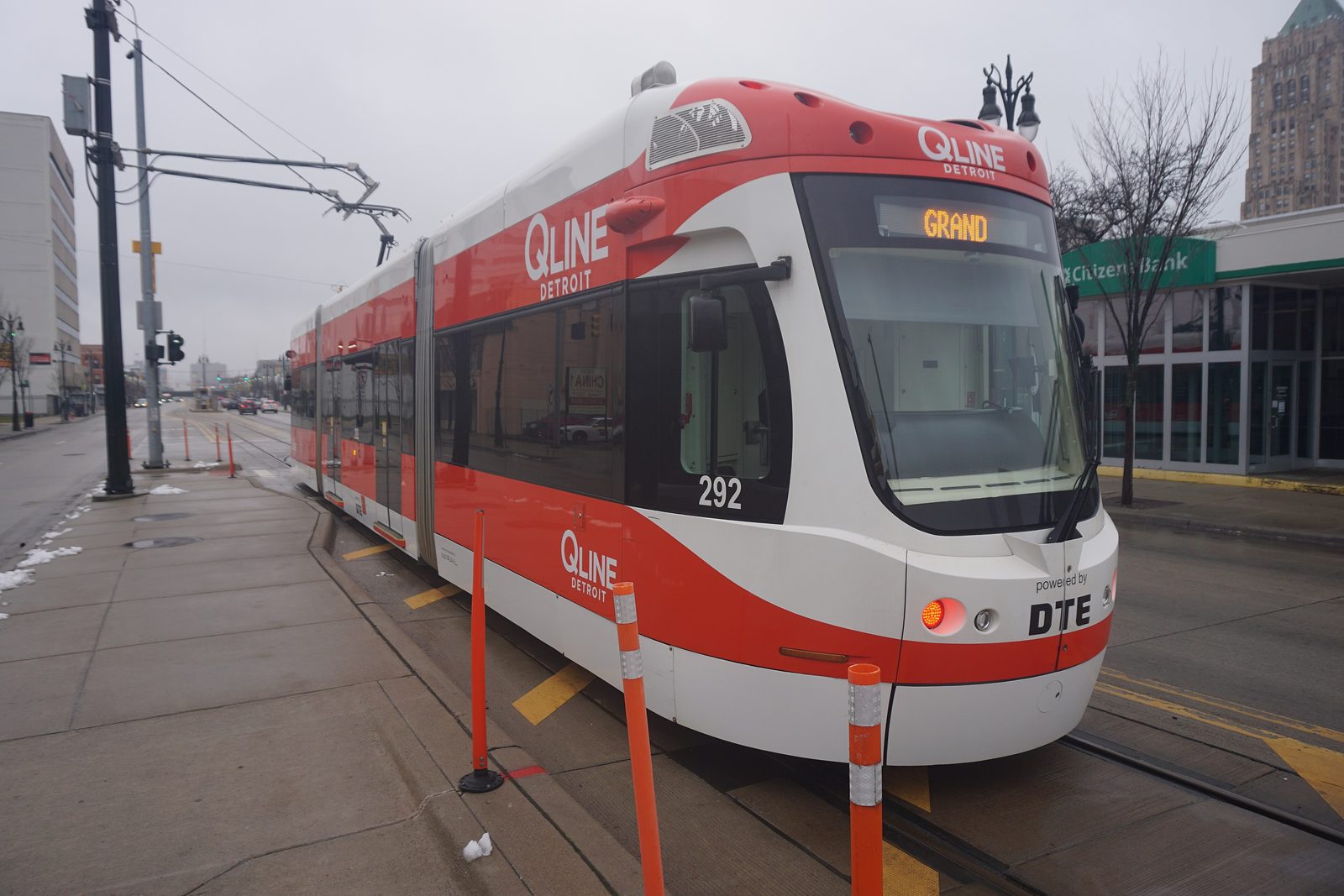
Car 292 at the Adelaide Street stop (2025)
Car 292 at the Adelaide Street stop (2025) · 42-BRT · CC BY-SA 4.0
  1. The RTA takes the wheel

    The RTA board votes unanimously on September 19 to take over, and on October 1 the QLINE becomes the regional authority’s, with about 45 staff and an annual budget of about $10 million. Matt Cullen: “There were 100 times that we could have taken our chips and walked away.”

    M-1 RAIL – QLINE Annual Report 2024 (PDF) · Crain’s, 2024-10-01 – RTA takes over the QLine · Mass Transit, 2024-09-20 – RTA board accepts transfer of QLINE

  2. Another million

    2024 ridership passes a million by late November; RTA chief Ben Stupka calls it the QLINE’s best year yet. The stops get Zoyes Creative’s “Every Stop is a Start” designs, funded by the Rocket Community Fund.

    WDIV, 2024-11-22 – QLINE surpasses 1 million riders in 2024 · RTA – The QLINE surpasses 1 million riders for 2024 · Zoyes Creative – QLINE “Every Stop is a Start”

  3. One app for the region

    The RTA, DDOT, SMART, Ann Arbor’s TheRide, MoGo and the People Mover come together in the Transit app: trip planning, real-time departures and tickets in one place.

    RTA, 2025-12-26 – Transit knits Southeast Michigan together

  4. The first full year under the RTA

    According to the RTA, about a million riders took the streetcar again in its first full year.

    RTA, 2025-12-26 – Transit knits Southeast Michigan together

  5. Summer hours

    Between Memorial Day and Labor Day the streetcar runs daily from 8 a.m. to midnight, every fifteen minutes, still free.
    RTA of Southeast Michigan – QLINE

Today · The QLINE is still free, runs every fifteen minutes and is operated by the RTA. Usually four of the six cars are in service; see where they are right now on the line map above.

06 / The machine

A battery streetcar on Woodward

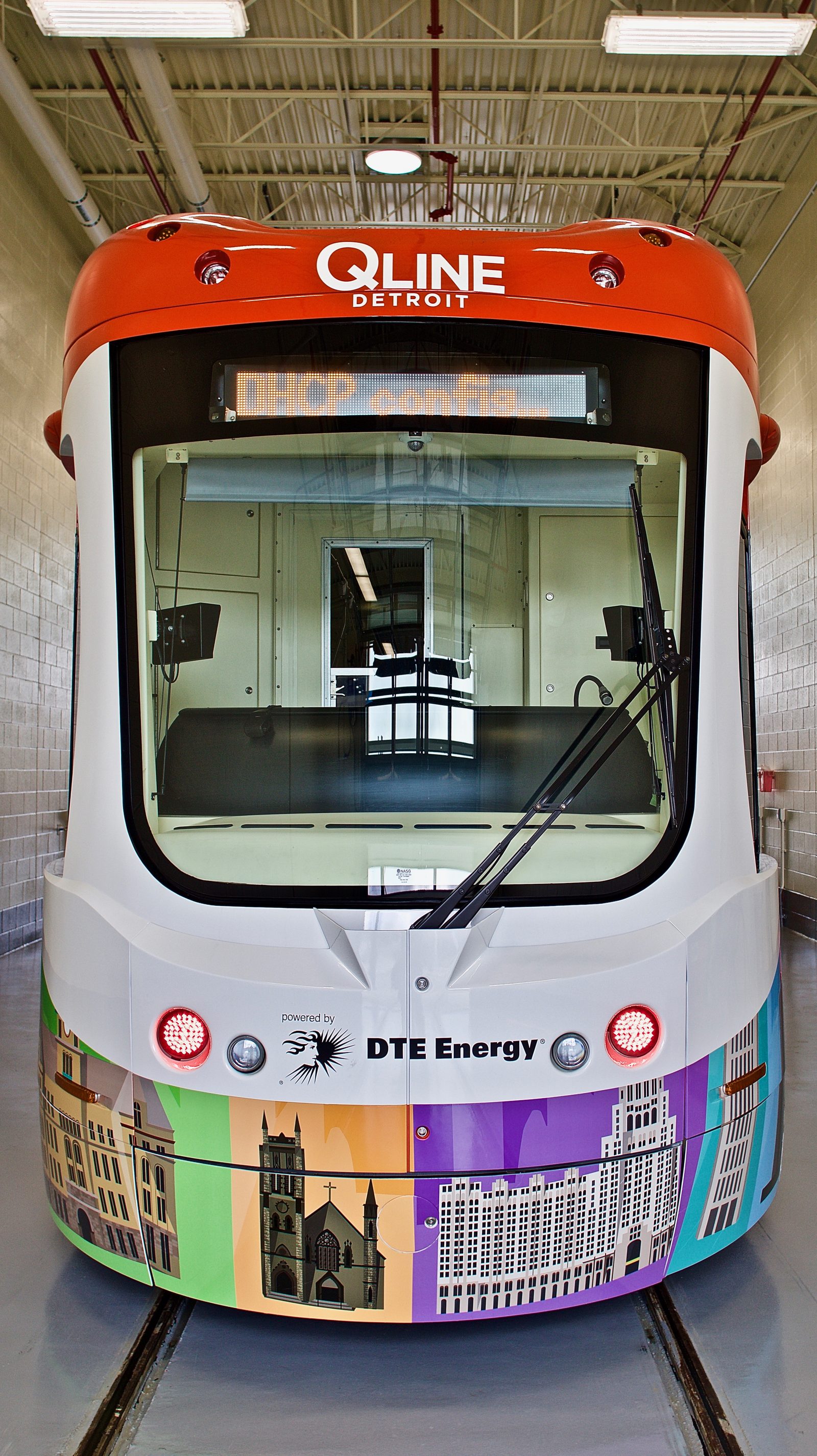
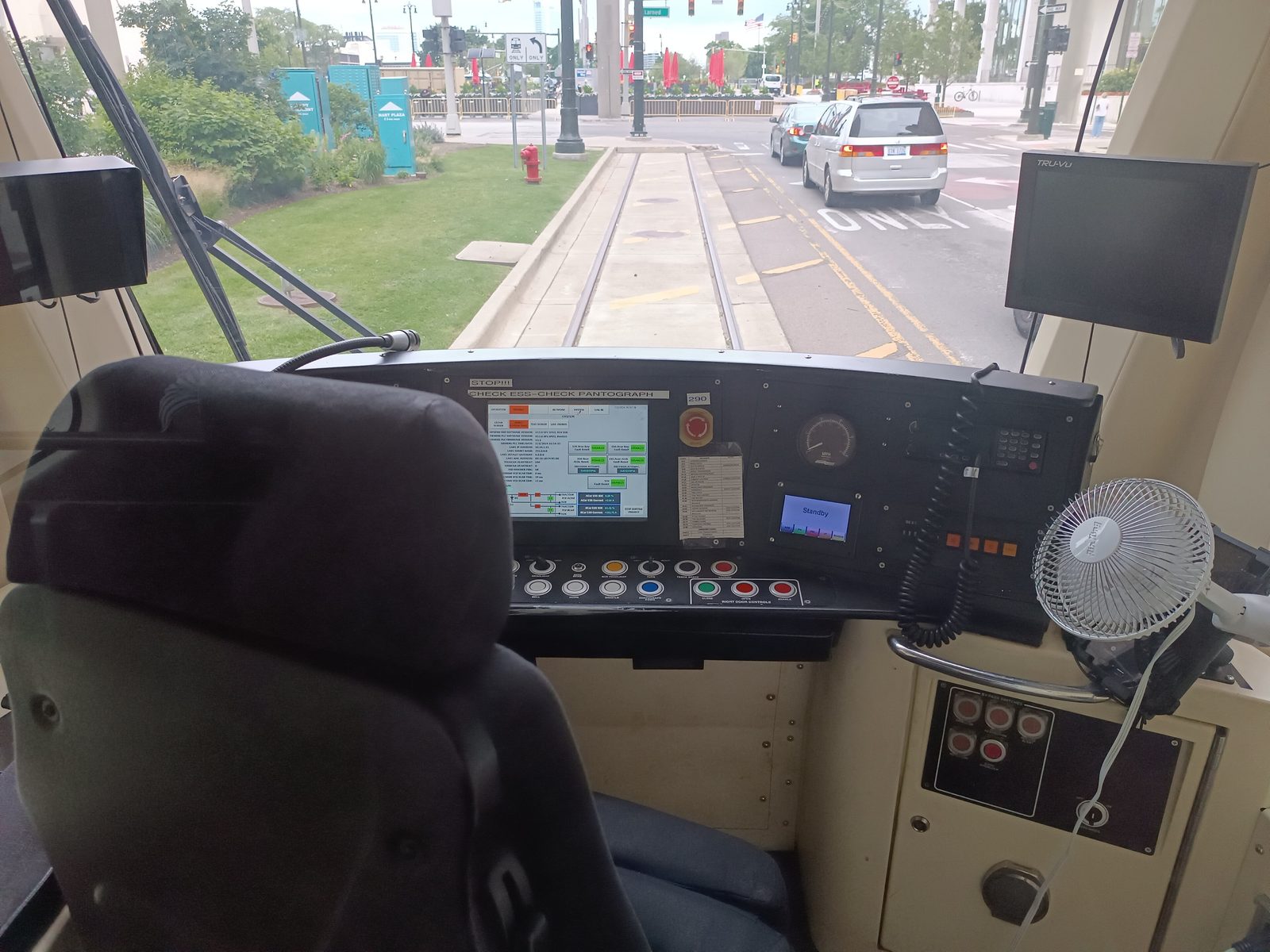
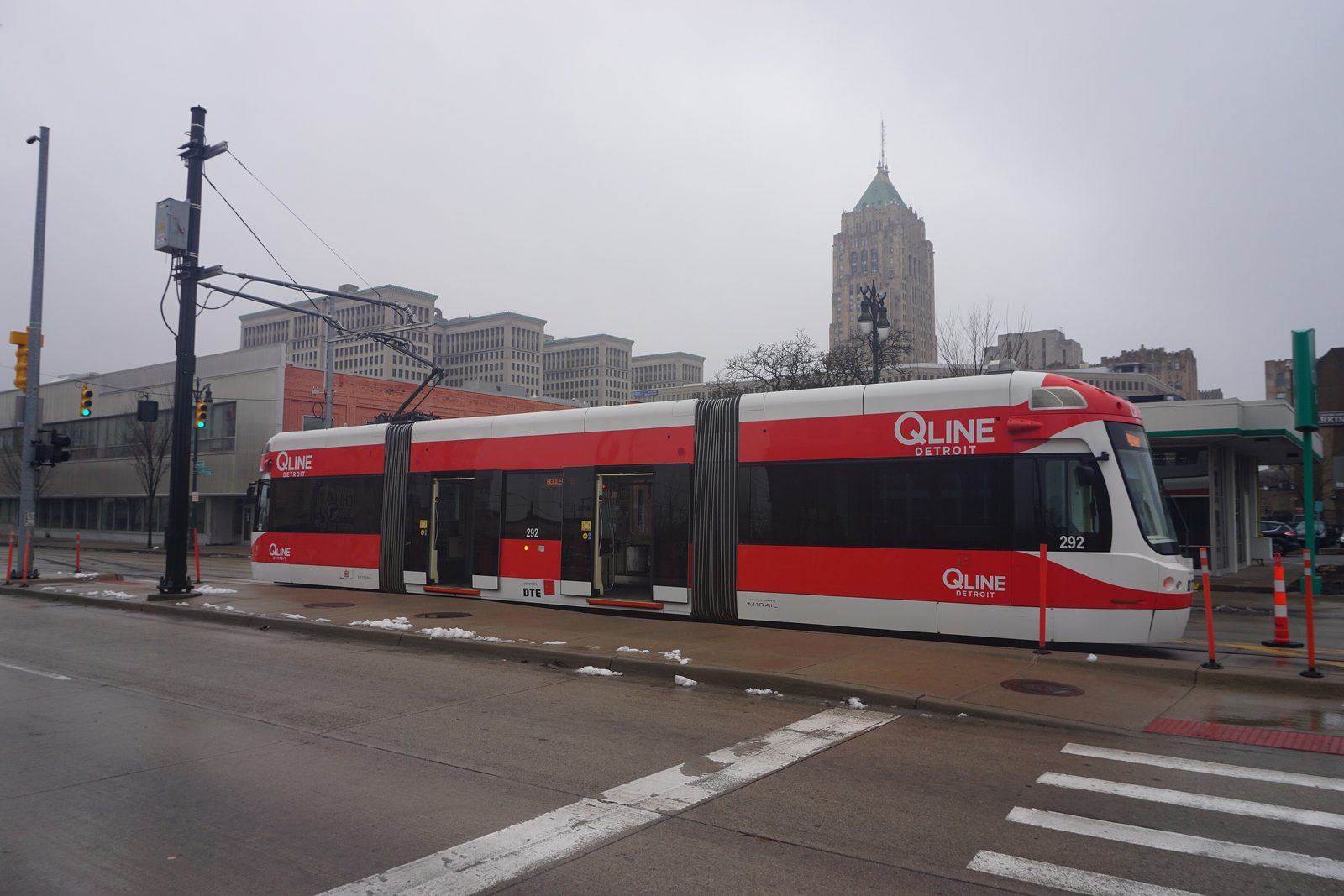
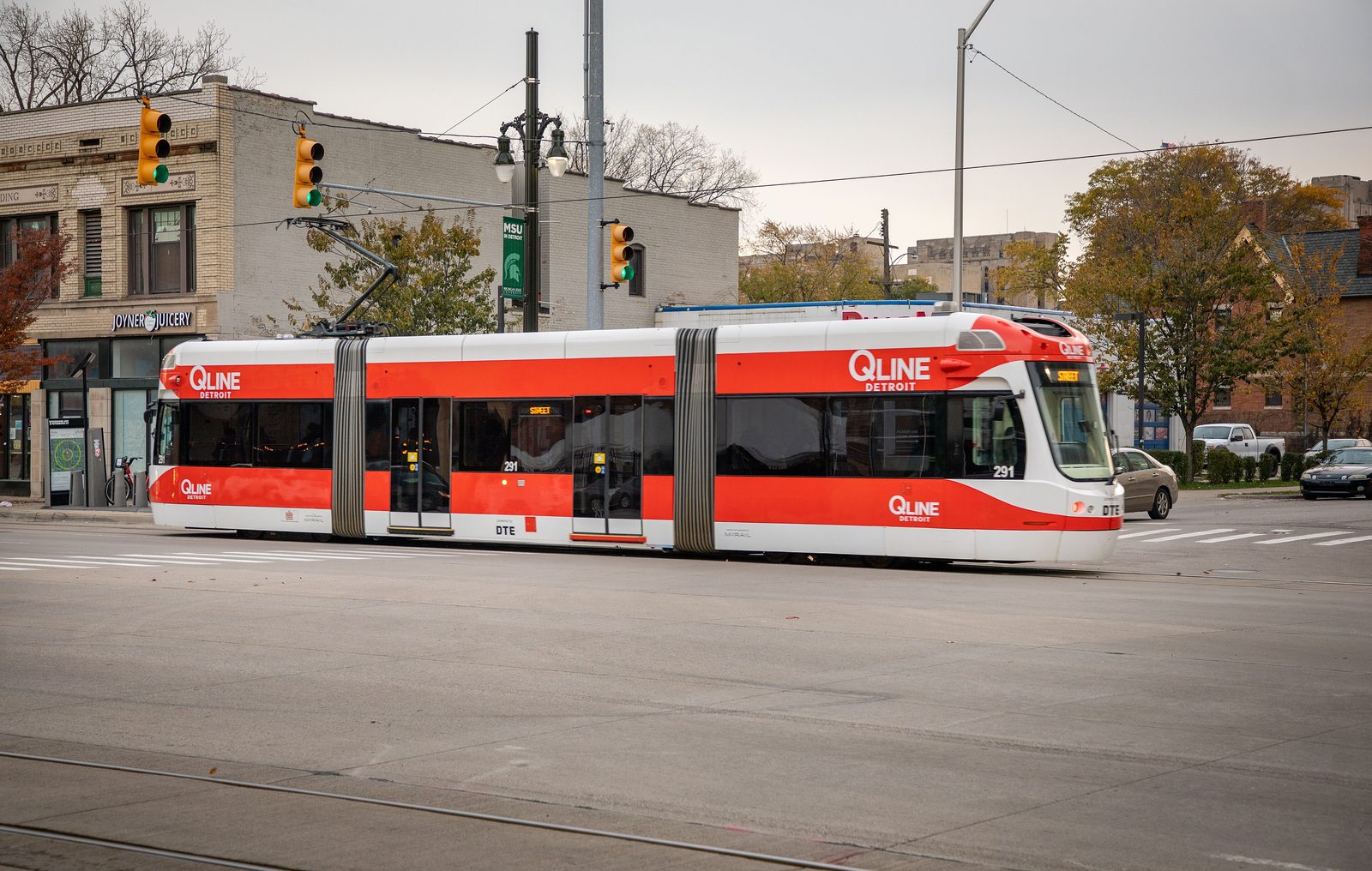
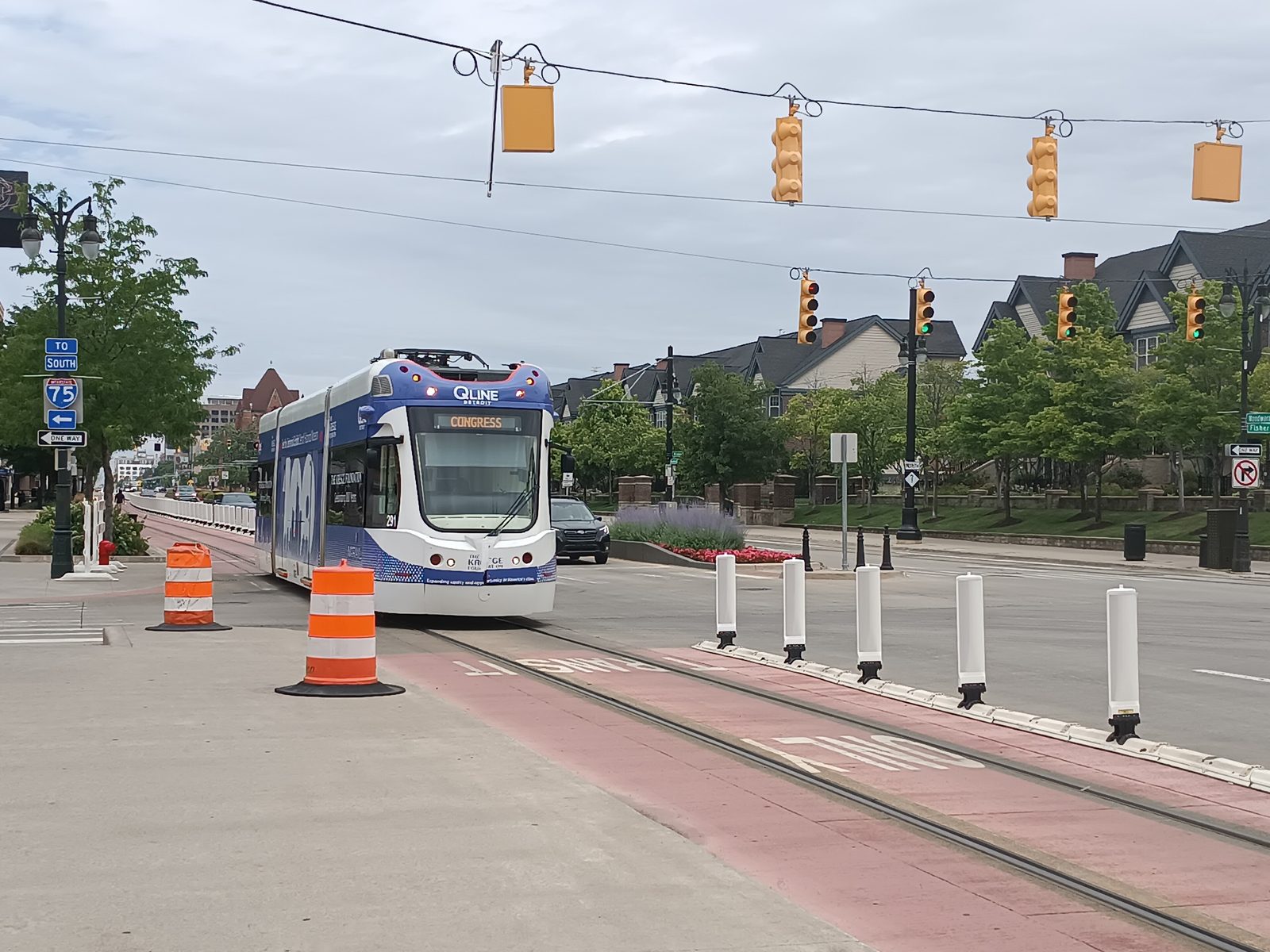
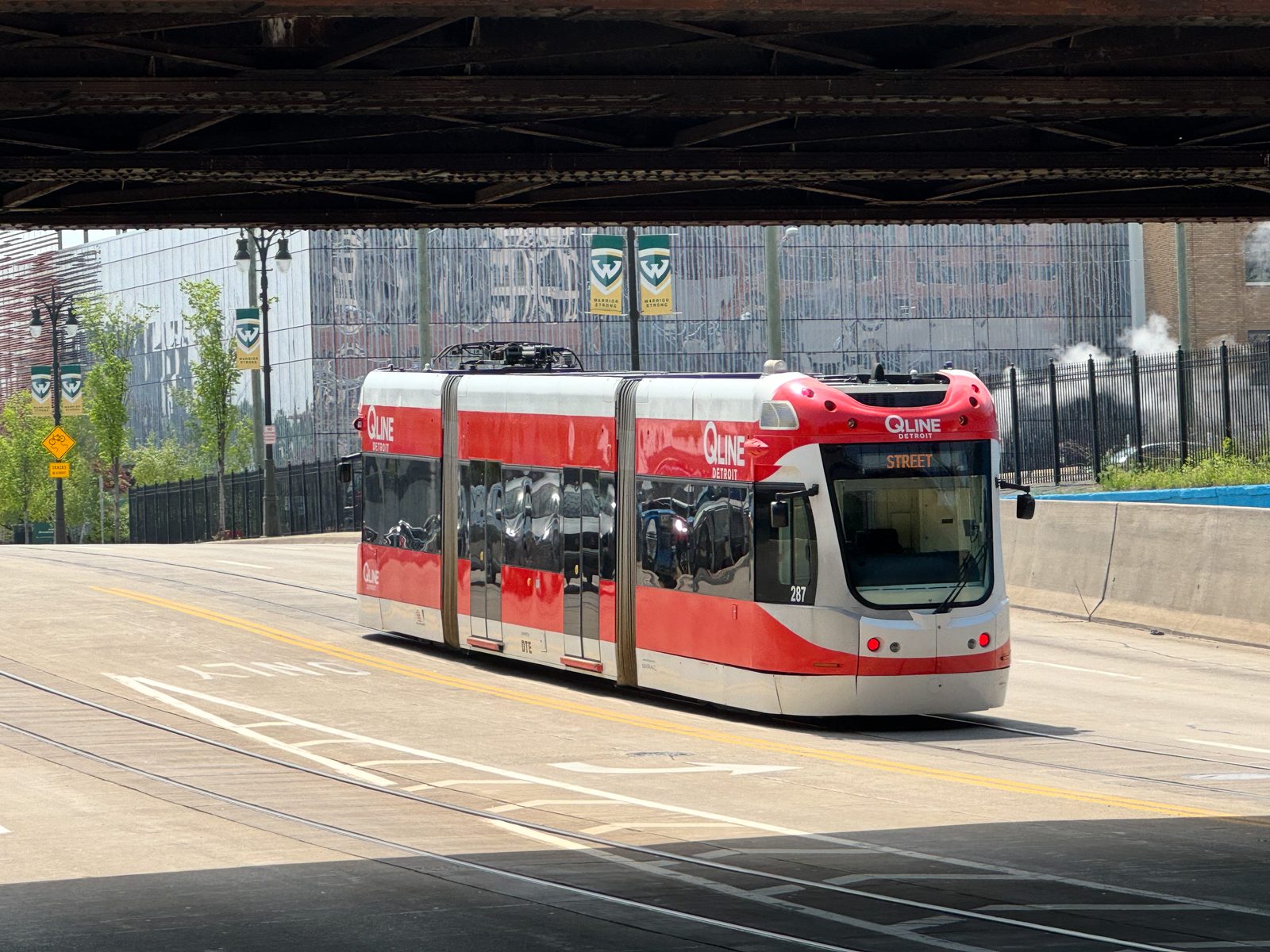
The QLINE’s six cars are Liberty Modern Streetcars from Brookville Equipment of Pennsylvania: three-section, articulated, double-ended trams with more than 70 percent low floor. They run on 750-volt direct current: where there is overhead wire they draw power through a pantograph and charge their on-board lithium-ion batteries, and where there is none they run on those batteries. The traction equipment comes from ABB. Brookville’s president called managing off-wire running the main innovation behind the Liberty’s design.

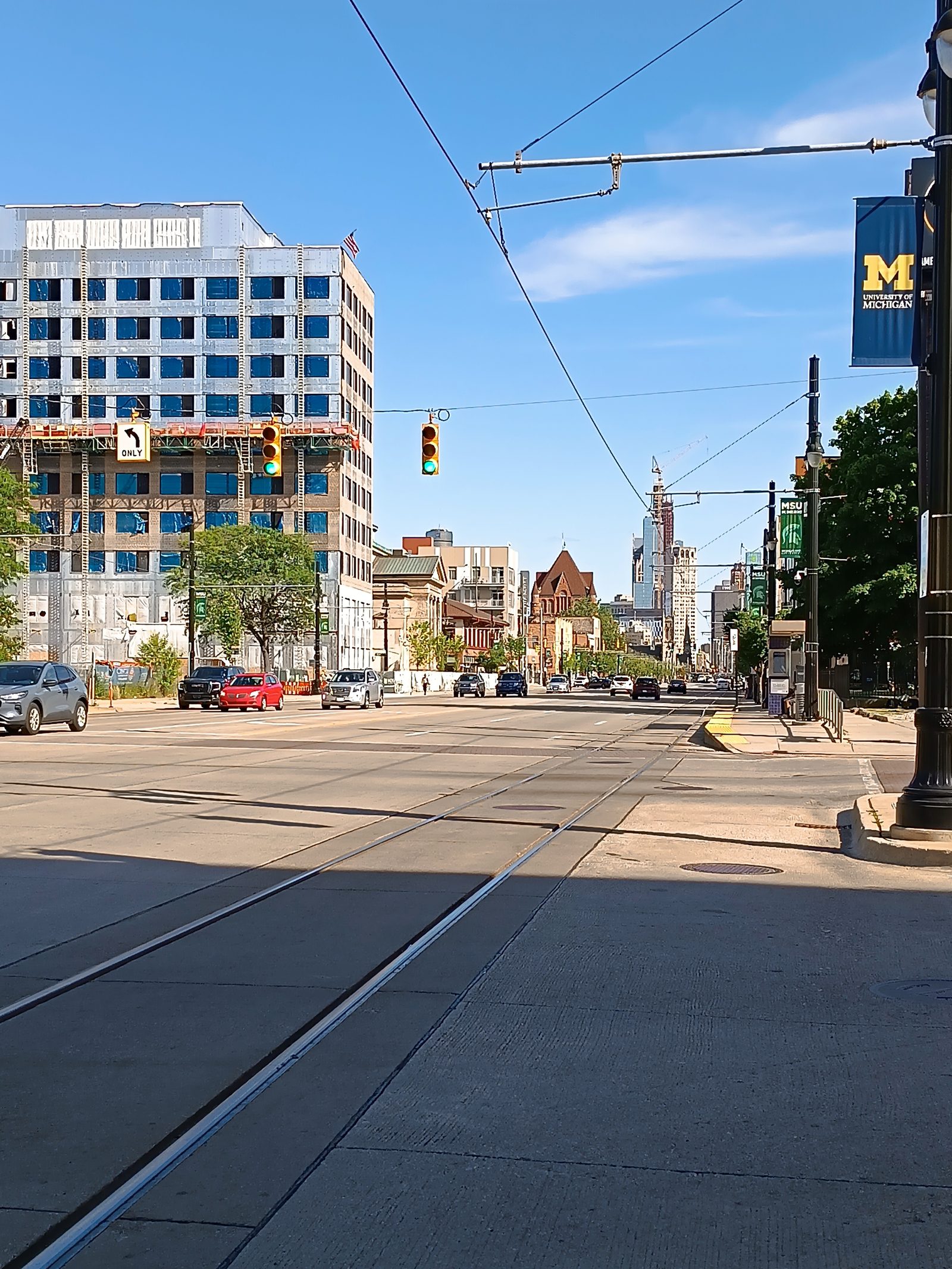
According to City of Detroit open data, the two longer wired sections run from Winder and Adelaide Streets to Canfield Street (1,437 meters) and from Hancock Street to Ferry Street (701 meters). Most of downtown, both freeway bridges and the north end are wire-free, apart from short stretches of overhead wire at a few stops such as Congress Street and Amsterdam Street: according to C3M, which designed the power system, the QLINE was the first streetcar to get charging points along its off-wire sections. In all, about 60 percent of the line has no wire. In its opening year the official guide called this the highest share of any streetcar system in the United States, and the 2018 one-year report said the cars ran off-wire 80 percent of the time.

Why? M-1 said it spared the historic look of Woodward, kept a maze of wires away from the depot and made maintenance simpler and safer. The streetcar shares the lane with cars at up to 35 mph (56 km/h), stops at red lights like everyone else, and gets signal priority at 26 intersections.

Cars
6 Brookville Libertyfleet numbers 287–292
Length
66.5 ftthree articulated sections
Width
8 ft 8 inBrookville
Riders
125including 32 seats
Power
750 V DCoverhead wire and lithium-ion battery
Overhead wire
1.3 mithe two longer sections: Winder–Canfield and Hancock–Ferry
Top speed
35 mph2026 safety brief, in mixed traffic
Gauge
4 ft 8½ instandard gauge
Built
2016–2017Brookville, Pennsylvania; $32 million contract
Depot
Penske Tech Center7520 Woodward Avenue, wire-free
Construction cost
$144 millionCrain’s, 2017; $187.3 million raised in all
Operator
RTAsince October 1, 2024

Average daily riders

Average riders a day. The streetcar did not run between March 2020 and September 2021.
YearRiders a day
20174,660 May–October, first six months
2019≈ 3,000 with fares
2021969 October–January, after the restart
20221,720 free
20232,765 over a million rides
20243,185 to September

Sources: the QLINE one-year report (2017), Crain’s (2019, 2021), the M-1 RAIL 2024 annual report (2022–2024). The NFL Draft day of April 25, 2024, with 24,693 riders, is the all-time daily record.

07 / Riding

How to ride the QLINE

The QLINE is free: no ticket, no pass, just get on. A streetcar comes every fifteen minutes, and the trip from Congress Street to Grand Boulevard takes 24 minutes.

Hours

Monday to Saturday
8 a.m.–midnight
Sunday
8 a.m.–9 p.m.
Summer (Memorial Day to Labor Day)
daily 8 a.m.–midnight

Today’s timetable: 0:00–0:09

The streetcar runs in traffic, so it can be late; live arrival times are on the platform screens and in the Transit app ↗. On holidays and event days, such as the Thanksgiving parade, check QLINE on X ↗.

Fare

Free

The QLINE has been free since September 2021. A 2022 state law provides up to $5 million a year for operations until September 30, 2039. According to the RTA, both the QLINE and the People Mover are free, with transfers at Grand Circus and Congress Street.

Accessibility and rules

  • High platforms and low floors leave only a minimal gap between platform and car.
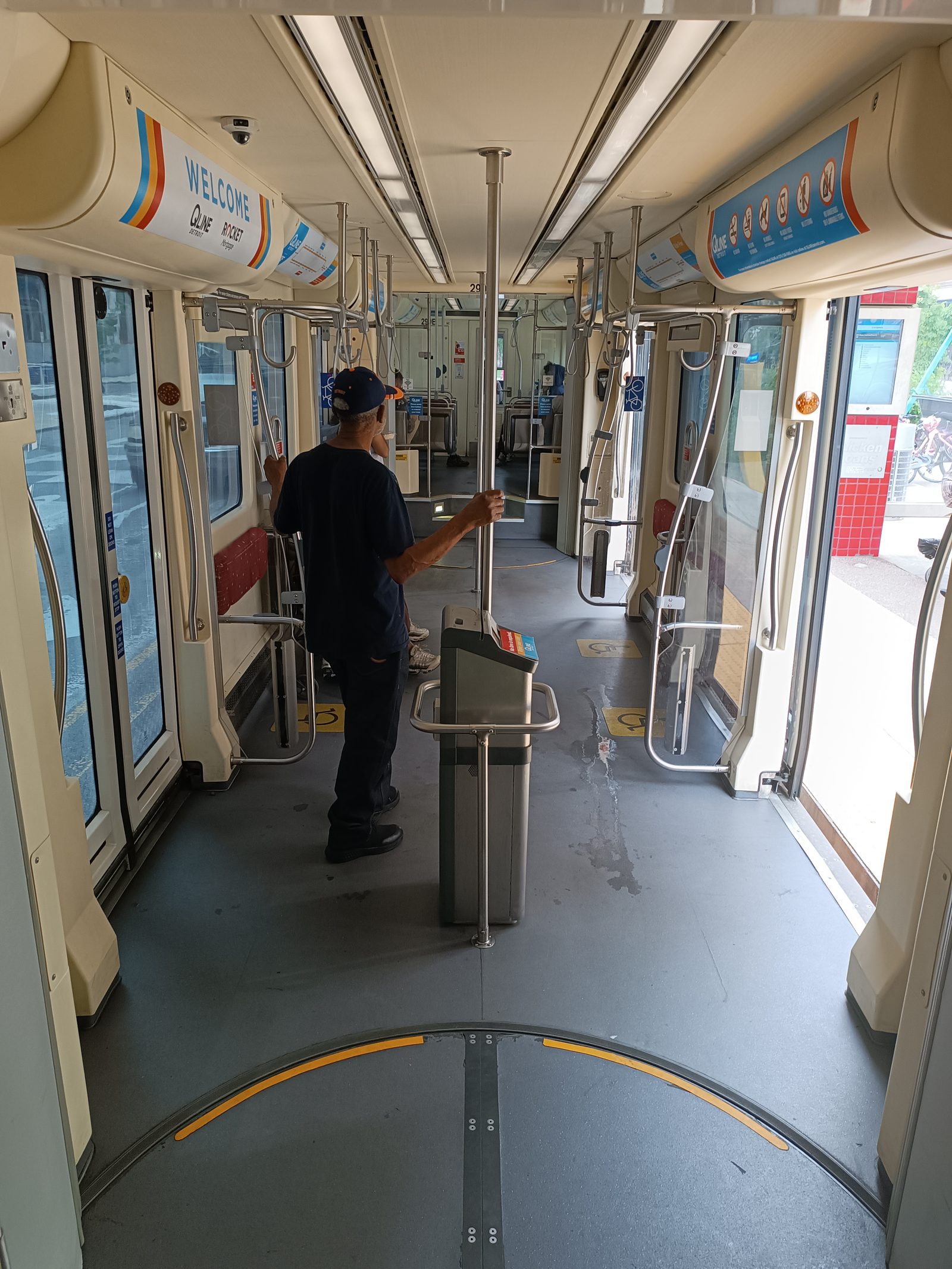
  • Wheelchair and stroller spaces and the fold-down seats reserved for older and disabled riders are in the center section.
  • Stops are announced by audio and on screens. To get off, press the blue “stop request” button.
  • Bikes ride upright on the hanging racks in the center section, space permitting. Personal stowable scooters are fine; rental scooters and bikes (Lime, Bird, MoGo and the like) are not.
  • Service animals only. No smoking, vaping or alcohol; food and drink only with a lid, music only through headphones, shirt and shoes required.
  • Cars are heated and air-conditioned, and stations are heated when temperatures drop below freezing. Free wifi on the cars and platforms.

Tips

  1. Streetcars leave in both directions every fifteen minutes; the platform screen shows when the next one is due.
  2. The streetcar stops where people are waiting or when someone presses the blue button; stand where the operator can see you.
  3. Northbound, look right for Comerica Park and the Detroit Institute of Arts, and left for the Fox Theatre, Little Caesars Arena, the Detroit Public Library and the Fisher Building’s tower.
  4. Transfer to the People Mover: at Grand Circus the station in the David Whitney Building is steps away, at Congress Street the Financial District station. Both are free.
  5. Amtrak: Detroit’s Amtrak station, where Wolverine trains leave for Chicago, is a block south of the Baltimore Street stop.
  6. Park and ride: from Friday to Sunday park for $5 in Wayne State’s Lot 12 (6050 Woodward, entrance off Harper Avenue) beside the Amsterdam Street stop.
  7. If you drive, never park beside the tracks: a badly parked car delays the streetcar by 27 minutes on average and gets towed.
  8. On a bike, cross the tracks at a right angle so your wheel does not catch in the rail groove.

Contacts

QLINE – customer servicenumber on the official stop map and timetable feed
(313) 528-3044
QLINE – contact formgeneral enquiries, riding and safety, careers, track access permits
qlinedetroit.com/contact-us ↗
Regional Transit Authority of Southeast Michigan (operator)
(313) 402-1020info@rtamichigan.org1001 Woodward Avenue, Suite 1400, Detroit, MI 48226
Penske Tech Center (depot and headquarters)
7520 Woodward Avenue, Detroit, MI 48202
M-1 RAIL – perks program, partners
info@m1rail.org
Live arrivals: Transit app
rtamichigan.org/transitapp ↗

Social media

Checked: 2026-09-26

08 / Culture

Stops, art and big days

The QLINE’s stops are small pieces of architecture, its cars are moving billboards, and the streetcar is part of the city’s big days, from the NFL Draft to the Grand Prix.

  • Architecture · 2017

    20 glass-and-concrete platforms with Pewabic tiles

    Detroit firm ROSSETTI designed the 20 platforms, each 12 by 98 feet: two L-shaped precast concrete pieces at right angles, joined by a glass panel. Every stop got locally made colored tiles from Pewabic Pottery, matched to its sponsor. The design won a 2017 ENR Midwest regional design award.

  • Design · 2024

    Every Stop is a Start

    In late 2024 the stops got a new look of dots and bold primary colors: seven original designs by Zoyes Creative across the 12 locations, funded by the Rocket Community Fund. The slogan: every stop is a start.

  • Poetry · 2017

    Jessica Care Moore on opening day

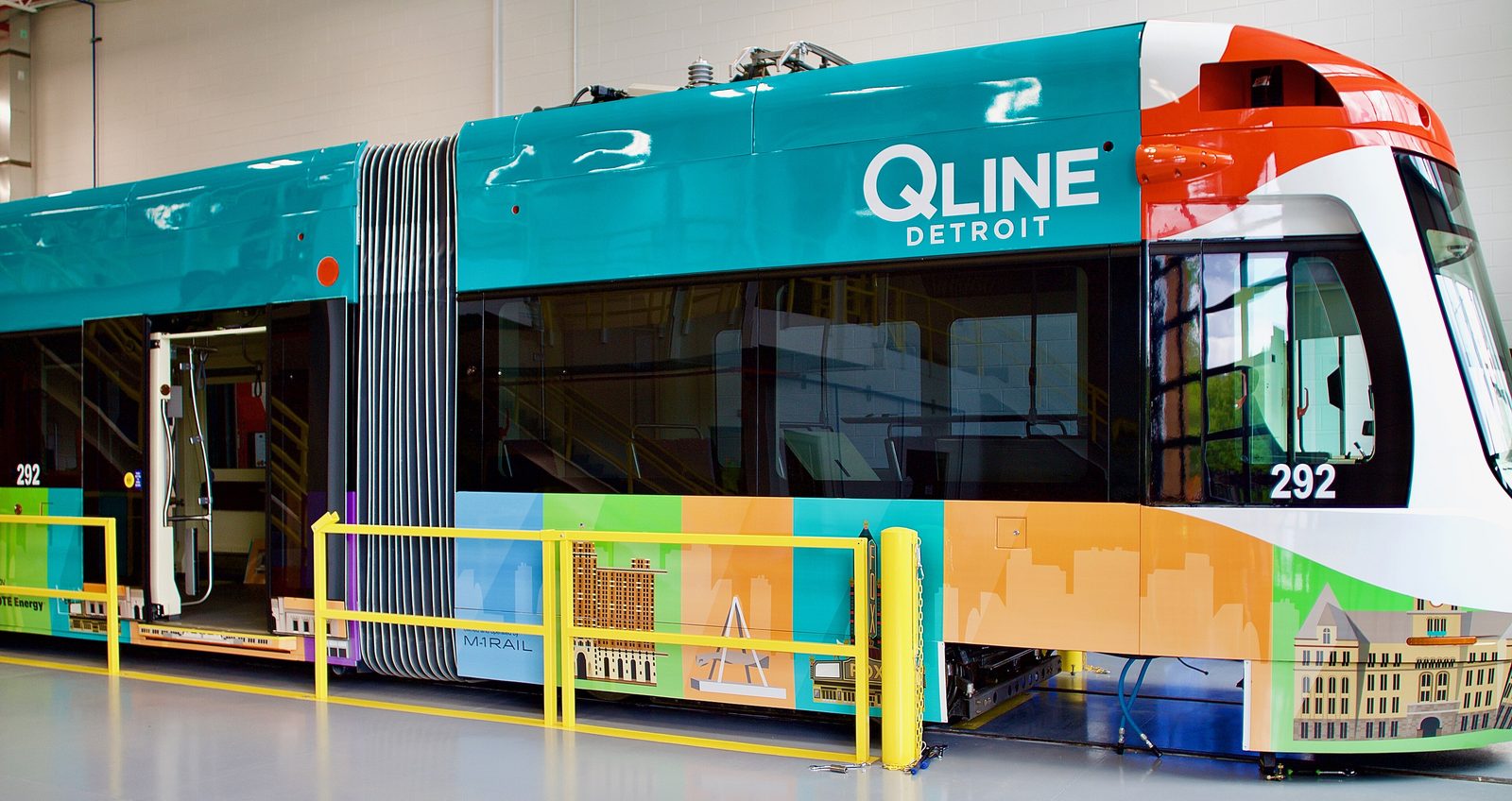
    The first streetcar to carry the public wore a wrap of Detroit images and a quote by Detroit poet Jessica Care Moore.

  • Event · 2024

    NFL Draft: four special streetcars

    During the three days of the 2024 NFL Draft in Detroit four cars wore special Draft wraps, service ran more often, and car parks by Grand Boulevard, Baltimore and Amsterdam Street worked as park-and-ride lots.

  • Event · 2024

    Grand Prix and Kresge 100

    In May 2024 the Chevrolet Detroit Grand Prix wrapped the downtown stops, and the QLINE invited race fans to the Congress Street stop in a video. In June the cars were wrapped for the Kresge Foundation’s 100th anniversary, tied to its exhibit at the Detroit Historical Museum near Ferry Street.

  • Holidays · 2024

    Santa on the Q and jazz on board

    With support from the Rocket Community Fund the streetcar has hosted holiday “Santa on the Q” rides and live music, including during the Detroit Jazz Festival.

  • Literature · 1938

    Elmore Leonard’s seven cents

    Crime novelist Elmore Leonard rode Detroit’s streetcars daily in the late 1930s, when a ride cost 7 cents, and took one of his first dates on a streetcar, he told Hour Detroit in 2012.

Did you know?

  • Why 287?

    The last car of Detroit’s old streetcar fleet was 286, so the QLINE’s first car became 287. The six cars continue the old numbering from 287 to 292.

  • The M-1 name

    Woodward Avenue is state highway M-1, which gave the non-profit M-1 RAIL its name.

  • It might have been RocketRail

    Before the name was chosen in 2016, Quicken Loans also filed trademarks for RocketRail, Qlink, Quickline and Qride.

  • A Chevy Volt on steroids

    M-1 operations chief Paul Childs described the hand-built cars this way in 2016. Each carries sandboxes holding up to 500 pounds of sand for winter traction.

  • A depot without wires

    According to HNTB the Penske Tech Center was the nation’s first streetcar maintenance facility to operate completely off-wire: the cars roll into the workshop on battery.

  • 272 percent

    On day one of the 2024 NFL Draft 24,693 people rode, 272 percent more than the 2017 record of 9,095.

  • Foxtown and Sibley

    The Montcalm Street stop is still “Foxtown Station” in the city’s data, and the Sproat and Adelaide stop appears as “Sibley Station” in the 2018 one-year report.

  • Detroit’s streetcars in Mexico City

    In 1955 and 1956, 183 nearly new Detroit PCC streetcars were sold to Mexico City for $3,000 to $4,000 apiece.

  • America’s first concrete road

    In 1909 the first mile of concrete road in the United States was laid on Woodward Avenue between 6 Mile and 7 Mile.

  • A double-decker from England

    The downtown heritage trolley of 1976–2003 used cars from Lisbon, Vevey in Switzerland and Burton upon Trent in England; the English one was a double-decker.

  • Its own tow truck

    Since 2022 the QLINE has towed cars parked on the tracks with its own donated tow truck. BridgeDetroit reported blockages falling from daily to about one every five days.

  • Detroit’s first transit lane

    The red “Transit Only” lane in front of Little Caesars Arena, painted in 2021, is Detroit’s first transit-only lane.

Videos

Videos play right here in YouTube’s privacy-enhanced (youtube-nocookie) player, only when you click.

10 / Questions

Frequently asked questions

How much does the QLINE cost?

Nothing. The QLINE has been free since September 2021; just get on, no ticket or pass needed.

When does it run?

Monday to Saturday 8 a.m. to midnight, Sunday 8 a.m. to 9 p.m.; in summer, between Memorial Day and Labor Day, daily from 8 a.m. to midnight. A streetcar comes every fifteen minutes.

How long is the full ride?

The timetable allows 24 minutes from Congress Street to Grand Boulevard, depending on traffic.

How many stops are there?

There are 20 platforms at 12 locations; at some of them each direction has its own platform and cross street (Sproat Street and Adelaide Street, MLK Boulevard and Mack Avenue). The official site now mentions 13 stops.

Where can I transfer to the People Mover?

At Grand Circus, where the People Mover station is in the David Whitney Building, and at Congress Street, near Financial District station. Both are free.
Does it really run on batteries?

Yes. About 60 percent of the line has no overhead wire, and there the cars run on on-board lithium-ion batteries charged on the wired sections. Most of downtown has no wire, apart from short stretches at a few stops.

Who runs it?

Since October 1, 2024 the Regional Transit Authority of Southeast Michigan (RTA). Before that the non-profit M-1 RAIL ran it, with the company Transdev operating it from 2017 to 2021.

Is it accessible?

Yes: high platforms, low floors, wheelchair space in the center of the car and audio and on-screen announcements.

Can I bring a bike or a scooter?

Bikes go on the hanging racks in the center section, space permitting. Personal stowable scooters yes, rental scooters and bikes no.

How do I know when the next one comes?

From the platform screens, the Transit app, or this page: the line map shows the streetcars with live GPS positions when the RTA feed is available.
Where can I park if I drive?

From Friday to Sunday in Wayne State’s Lot 12 beside the Amsterdam Street stop, for $5. Never park beside the tracks: cars are towed.
How do I get to the Amtrak station?

Get off at Baltimore Street: Detroit’s Amtrak station (11 West Baltimore Avenue) is a block to the south.

Can I bring my dog?

Only service animals.

Sources · checked: 2026-09-26

Every fact is sourced. Where sources disagree (the number of stops, the weight of the cars or the construction cost, for example) we follow the primary, official source and say so in the text. The timetable comes from the QLINE’s official GTFS data and live positions from the RTA’s feed.

Save the plan. Share the moment.