Law / Politics
Homer S. Ferguson
1889–1982 · judge, U.S. senator, diplomat
Detroit lawyer and Wayne County circuit judge whose one-man grand jury exposed city corruption (1939–1941), launching him into the U.S. Senate (1943–1955).
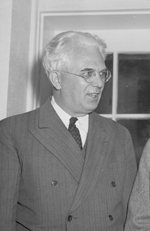
- Born
Harrison City, Pennsylvania- Died
Grosse Pointe, Michigan
aged 93- Birth name
- Homer Samuel Ferguson
- Also known as
- Homer Ferguson
- Detroit years
- 1913–1954, 1976–1982
01 / The Detroit story
The Detroit story
Homer Ferguson, a Pennsylvanian, graduated from the University of Michigan law school in 1913 and began practicing in Detroit. From 1929 to 1942 he was a judge of the Wayne County Circuit Court and also taught at the Detroit College of Law. In 1939, acting under Michigan's unusual one-man grand jury law, he opened an investigation into graft that uncovered police protection of gambling rackets and led to the conviction of former mayor Richard Reading, the Wayne County prosecutor and dozens of police officers and officials. The fame of that probe carried him into the U.S. Senate as a Republican in 1942. In Washington he helped create the joint congressional inquiry into Pearl Harbor, pressed anticommunist investigations and chaired the Republican Policy Committee. Defeated in 1954 by Detroit pipefitter Patrick McNamara, he served as ambassador to the Philippines and for twenty years as a judge of the U.S. Court of Military Appeals, then retired to Grosse Pointe, where he died in 1982.
Highlights
- Wayne County circuit judge, 1929–1942
- Led the Detroit one-man grand jury corruption probe (1939–1941)
- U.S. senator from Michigan, 1943–1955
- U.S. ambassador to the Philippines, 1955–1956
- Judge of the U.S. Court of Military Appeals, 1956–1976